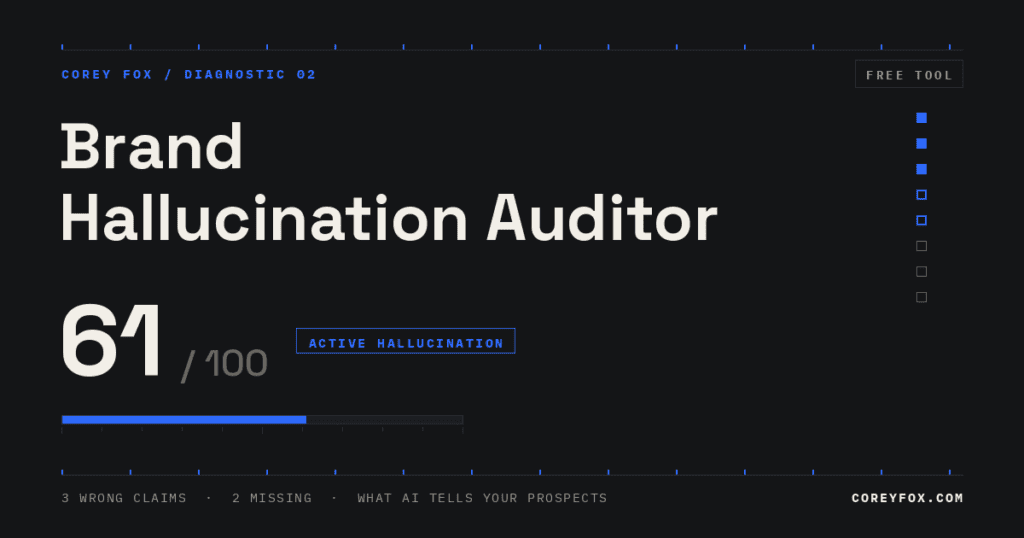
Brand Hallucination Auditor
Your prospects ask ChatGPT about you before they ever visit your site. This instrument asks the same questions, compares every AI answer against your real facts, and flags what the machines are getting wrong.
Fill in what is actually true about your business. The audit asks AI six prospect-style questions from public information only, then grades every answer against this sheet. More detail means a sharper diff.
Takes 30 to 60 seconds. The audit queries live AI with web search, so results reflect what prospects actually see today.
The Brand Hallucination Auditor is a free tool that asks AI the six questions prospects ask before contacting a business, then grades every answer against the facts you provide.
It flags wrong claims, missing information, and confusion with other companies, and scores how accurately AI represents your brand from 0 to 100.
What is a brand hallucination?
A brand hallucination is a false or fabricated claim an AI system makes about a business: wrong pricing, services the company does not offer, outdated locations, confusion with a similarly named company, or invented details presented as fact.
Because AI assistants answer with confidence, prospects rarely double check, and the business never learns the deal was lost.
Hallucinations happen because language models assemble answers from whatever public record exists.
If your public record is thin, inconsistent, or contradicted across sources, the model fills gaps with its best guess.
A confident wrong answer at the exact moment a prospect is evaluating you is worse than no answer at all.
What the audit tests
The auditor runs the six questions prospects actually put to AI assistants, using live web search so the results reflect what people see today:
| Question | What a wrong answer costs |
|---|---|
| What is this company and what do they do? | Miscategorization sends the wrong buyers, or none |
| What services do they offer? | Prospects rule you out for work you actually do |
| How much do they cost? | Wrong pricing disqualifies you before contact |
| Where are they located and what areas do they serve? | Local buyers get routed to competitors |
| Are they reputable? | Reputation errors kill trust silently |
| What are the alternatives? | Brand confusion hands your equity to a stranger |
Each answer is diffed against your fact sheet and marked CORRECT, WRONG, MISSING, or UNVERIFIED, with severity weighted toward the claims that cost deals: pricing, services, location, and reputation.
What the Consensus Score means
| Score | Band | What it tells you |
|---|---|---|
| 90 to 100 | Consensus strong | AI represents you accurately. Protect the record. |
| 70 to 89 | Drift detected | Mostly right with gaps or stale details. Correct before they compound. |
| 40 to 69 | Active hallucination | AI is telling prospects things that are not true. Revenue is leaking silently. |
| Below 40 | Critical misrepresentation | The machines have the wrong company, the wrong facts, or nothing at all. |
How to fix what AI gets wrong
You cannot email ChatGPT a correction. You fix hallucinations by fixing the public record the models learn from and search against:
- Entity clarity on your own site. A machine-readable statement of who you are, what you do, what you charge, and where you operate, stated consistently on the pages models actually retrieve.
- Clean structured data. Accurate Organization, LocalBusiness, and Service schema with no competing or contradictory markup. Conflicting schema teaches models conflicting facts.
- Consistent profiles everywhere. Your name, category, services, and locations must match across your site, Google Business Profile, directories, and social profiles. Inconsistency reads as uncertainty, and uncertainty gets filled with guesses.
- Authoritative third-party citations. Models trust claims that independent sources repeat. Coverage, listings, and mentions that state your facts correctly outweigh anything you say about yourself.
- Disambiguation from name twins. If a similarly named company exists, your public record needs explicit differentiators, or their facts become your facts.
This is the core of Answer Engine Optimization: making your brand the source of truth machines converge on. If your audit came back with wrong claims, book the free revenue audit and I will show you exactly which sources are feeding AI the bad information, or see the service tiers for ongoing consensus monitoring.
Related: run the AI Overviews Revenue Leak Diagnostic to measure what AI answers are costing you in clicks, not just accuracy.
Frequently asked questions
Is the Brand Hallucination Auditor free?
Yes. The Consensus Score, summary, and first findings are free with no signup. Your email unlocks the complete findings table and the correction plan. There is no paid version of the tool.
Corrections start with knowing where AI builds its answers: check which sources Google cites for your money queries.
Where does the audit get its answers?
The audit queries a live AI model with web search enabled and instructs it to answer only from public information, exactly as a prospect-facing assistant would. Your fact sheet is used solely as the grading key, never as a source for the answers.
Will the results be the same every time?
Not exactly. AI answers vary by model, day, and phrasing, which is precisely why hallucinations are dangerous. The audit is a representative snapshot. If a claim comes back wrong once, some share of your prospects are hearing it.
My business barely showed up at all. Is that better than being wrong?
Only slightly. Missing means AI recommends competitors when prospects ask for options in your category. Invisibility and misrepresentation are the same problem at different stages, and both are fixed by building an accurate, consistent public record.
How do I correct what AI says about my business?
By fixing the sources models rely on: entity-clear pages on your site, accurate structured data, consistent business profiles, and third-party citations that state your facts. Models converge on the version of you the public record repeats most consistently.
How often should I re-run the audit?
Quarterly for a stable business, and 30 to 60 days after any correction work to confirm the record took. AI models update their retrieval constantly, so a clean score is a state to maintain, not a box to check.