
What is AEO (Answer Engine Optimization)? The Complete Guide
AEO (Answer Engine Optimization) is the practice of optimizing your digital presence to rank in AI search engines like ChatGPT, Perplexity, and Claude. Unlike traditional SEO which targets Google’s 10 blue links, AEO focuses on getting your brand cited in AI-generated responses where 40% of searches now happen.
Why does AEO matter now?
The search landscape is undergoing its biggest shift since Google launched in 1998.
In January 2023, ChatGPT processed 1.6 billion visits. By December 2025, that number reached 3.7 billion monthly visits. Perplexity added 10 million users in the same period. Claude’s usage grew 300% year-over-year.
The numbers tell the story:
Search behavior is changing:
- 40% of searches now happen in AI chat interfaces (ChatGPT, Perplexity, Claude)
- AI search usage is growing 40% year-over-year
- Expected to reach 60% of total searches by end of 2026
- Google search traffic declined 10% in 2025
Traditional SEO is declining:
- Google’s “zero-click” searches reached 65% in 2025
- AI Overviews push organic results below the fold on mobile
- Click-through rates to websites dropped 25% year-over-year
- Users get answers in AI chat, never visit websites
The business impact:
When someone asks ChatGPT “What’s the best CRM for small businesses?”, they get an answer immediately. They don’t click through to 10 different websites. They don’t scroll through Google results.
They get a recommendation. They might get 3-5 options. If your brand isn’t cited in that response, you don’t exist to that buyer.
This isn’t theoretical. Companies already report:
- 30-50% of Google traffic evaporating
- Increases in direct searches for recommended brands
- AI referral traffic showing up in analytics
- Buyers arriving more informed, asking specific questions
The businesses winning in 2026 are the ones optimizing for where searches actually happen: AI engines.
You can see this live for any keyword with the free AI Overview and SERP feature checker, and compare it against the classic organic top 100.
How does AEO work?
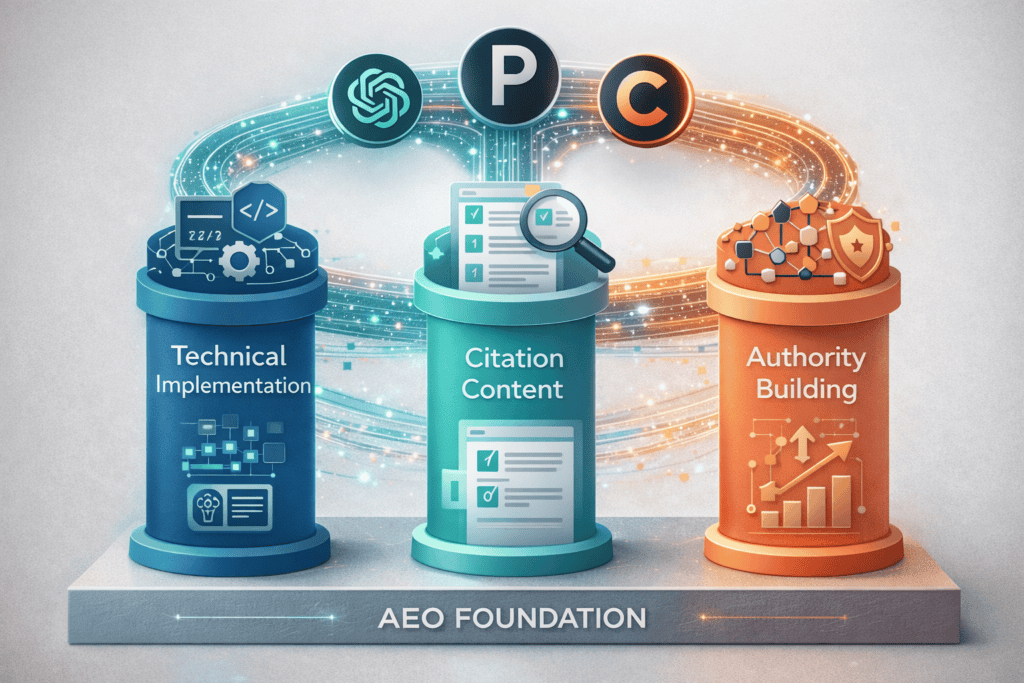
AEO has three core components: technical implementation, citation-optimized content, and authority building. Each serves a specific purpose in making your brand citable by AI engines.
How do you implement schema markup for AEO?
AI engines need machine-readable data to understand your business.
Why schema markup matters:
When ChatGPT or Perplexity scrapes your website, they’re looking for structured data. Schema markup is the language that tells AI engines: “This is who we are. This is what we do. This is how to contact us.”
Without schema, AI engines have to guess. With schema, they know.
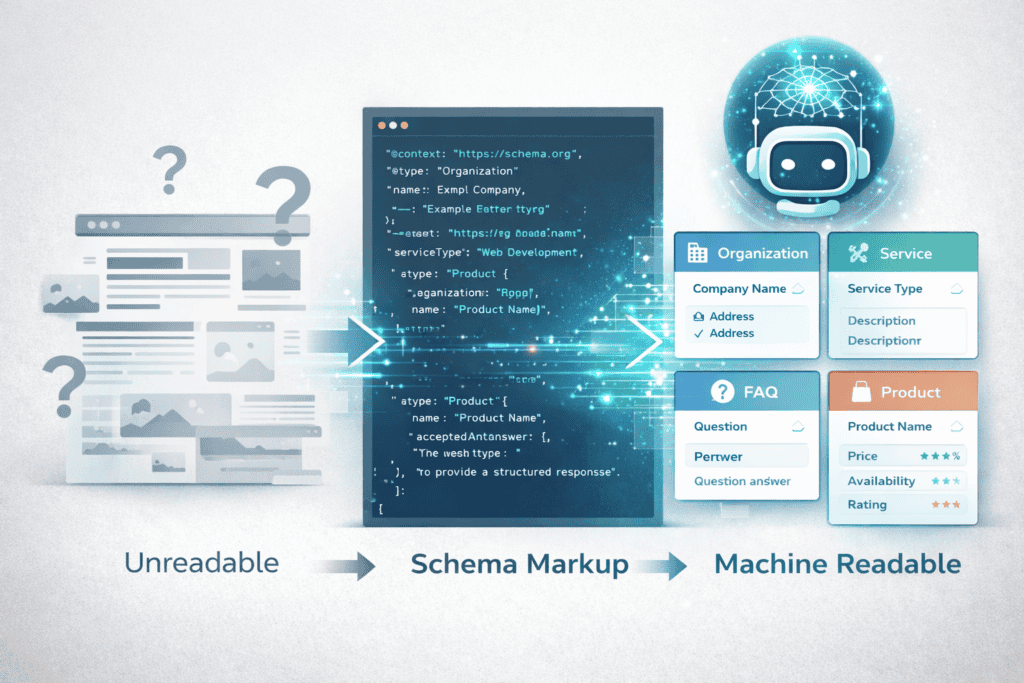
Essential schema types for AEO:
Organization Schema – Identifies your business entity:
- Company name, founding date, founder
- Official description
- Contact information (email, phone, address)
- Social media profiles
- Logo and images
Service Schema – Defines what you offer:
- Service names and descriptions
- Pricing (if you share it publicly)
- Service areas
- What’s included in each service
Product Schema – For e-commerce:
- Product names and descriptions
- Prices and availability
- Reviews and ratings
- Images and specifications
FAQ Schema – Common questions:
- Answers AI engines can cite directly
- Increases likelihood of citation
- Provides “ready-to-cite” content
Why this works:
AI engines prioritize cited sources that have clear, structured information. When Perplexity cites a source, it’s often pulling from schema markup because it knows that data is accurate and intentionally published.
Citation-Optimized Content
AI engines cite content that follows specific patterns.
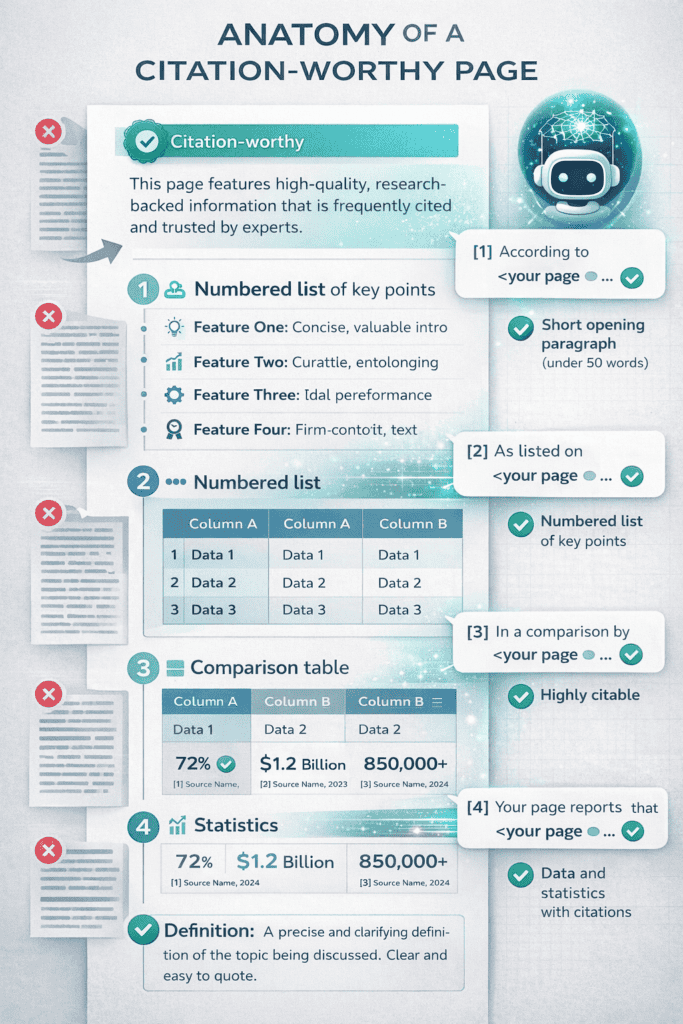
The citation formula:
- Opening paragraph under 50 words – AI engines truncate long intros. Your first paragraph needs to be citation-complete. It should answer: What is this? Why does it matter?
- Numbered lists – AI engines cite numbered lists 3x more than paragraph text. “5 ways to…” and “3 steps to…” get cited regularly.
- Comparison tables – Side-by-side comparisons get cited frequently. “Tool A vs Tool B” formatted as a table is highly citable.
- Specific data points – “According to [source], 40% of users…” with dates and citations makes your content trustworthy and citable.
- Definition-style content – Glossary pages with clear, under-50-word definitions are citation gold.
Content types that get cited most:
Glossary pages:
- Define industry terms clearly
- Keep definitions under 50 words
- Add expanded explanations below
- Include usage examples
- Link to related terms
Comparison pages:
- “[Your Category] Options Compared”
- Objective pros/cons
- “Best for” recommendations
- Pricing comparisons
- Feature tables
Statistics pages:
- “[Industry] Statistics for 2026”
- Sourced data with dates
- Clear methodology
- Updated regularly
- Categorized by topic
How-to guides:
- Step-by-step processes
- Numbered instructions
- Clear expected outcomes
- Time estimates
- Common mistakes to avoid
Authority Building
AI engines trust sources with established authority.
Where authority comes from:
Backlinks from cited sources:
- If Forbes cites you, and AI engines cite Forbes, they’re more likely to cite you
- Focus on getting links from sources AI already trusts
- Digital PR placements matter more than generic backlinks
Answers on high-authority platforms:
- Reddit (especially established subreddits)
- Quora (high-visibility questions)
- Stack Exchange (technical topics)
- Industry forums
HARO and media mentions:
- Journalists cite experts
- AI engines cite journalism
- Being quoted in articles builds authority
- Even small publications count
Wikipedia presence:
- Extremely high trust signal
- Difficult to achieve
- Worth pursuing for established brands
- Alternative: Wikidata entries
Brand co-occurrence:
- Being mentioned alongside industry leaders
- Appearing in “top [category]” lists
- Comparison articles with established competitors
- Industry roundups and expert compilations
The compound effect:
Authority builds slowly but compounds. Each citation makes the next one more likely. Each authoritative backlink increases citation probability. Each platform where you’re active strengthens your entity.
This is why AEO is a 90-180 day strategy, not a 30-day tactic.
AEO vs SEO: what’s the difference?
| Aspect | Traditional SEO | AEO (AI Engine Optimization) |
|---|---|---|
| Primary Goal | Rank in Google’s top 10 results | Get cited in AI-generated responses |
| Target Platforms | Google, Bing | ChatGPT, Perplexity, Claude, Gemini |
| Success Metric | Keyword rankings, organic traffic | Citation frequency, brand mentions |
| Content Focus | Keywords, search intent | Citation-worthy facts, structured data |
| Technical Foundation | Meta tags, site speed, mobile optimization | Schema markup, entity optimization |
| Backlink Strategy | Domain authority, PageRank | Citation authority, trusted sources |
| Timeline | 3-6 months for rankings | 6-12 weeks for first citations |
| Content Length | 2,000+ words for competitiveness | Concise, citable (opening <50 words) |
| Update Frequency | Quarterly refreshes | Continuous (AI training is ongoing) |
| Measurement | Google Analytics, Search Console | AI citation tracking, brand monitoring |
Key differences explained:
SEO aims for traffic. The goal is to rank #1 so users click through to your website.
AEO aims for citations. The goal is to be the answer AI provides, whether users click or not.
SEO is competitive for positions. Only 10 results on page one. You’re fighting for one of those spots.
AEO is collaborative. AI engines can cite multiple sources. You’re not displacing competitors; you’re establishing authority alongside them.
SEO requires significant content. Long-form, comprehensive content ranks better in Google.
AEO requires precise content. Clear, citation-worthy facts rank better in AI. Concision wins over comprehensiveness.
Both still matter. You need both strategies. SEO drives traffic. AEO drives citations and brand awareness. They work together.
How to Get Started with AEO
Implementing AEO follows a three-step process: technical foundation, citation content, and authority building.
Step 1: Implement Schema Markup (Week 1-2)
Start with Organization Schema:
Every business needs Organization Schema on their homepage. This tells AI engines who you are.
Required fields:
- Legal business name
- Founded date
- Description (2-3 sentences)
- Contact information
- Website URL
- Social profiles
How to implement:
- Generate schema using a schema generator or AI assistant
- Copy the JSON-LD code
- Paste in your website’s
<head>section - Validate at schema.org/validator
- Submit to Google Search Console
Add Service/Product Schema:
If you sell services, add Service Schema. If you sell products, add Product Schema.
Include:
- Service/product names
- Descriptions
- Pricing (optional but helpful)
- Availability
- Customer reviews (if you have them)
Add FAQ Schema:
Create an FAQ page answering your most common questions. Add FAQ Schema so AI engines can cite your answers directly.
Time investment: 4-8 hours for complete schema implementation
Technical skill required: Basic HTML editing or WordPress plugin usage
Tools needed: Schema.org validator, WordPress schema plugin, or custom code
Step 2: Create Citation-Optimized Content (Week 3-8)
Priority content to create:
5 Glossary Pages – Define key industry terms:
- Keep definitions under 50 words
- Expand with examples below
- Add FAQ schema
- Link related terms
- Update annually
2-3 Comparison Pages – Compare options objectively:
- “[Category] Comparison Guide”
- Include your offering and competitors
- Be honest about when competitors are better
- Use comparison tables
- Cite pricing and features
1 Statistics Page – Data-driven content:
- “[Industry] Statistics for 2026”
- Source all data
- Include dates
- Organize by category
- Plan to update quarterly
3-5 How-To Guides – Step-by-step processes:
- Numbered steps
- Expected outcomes
- Time estimates
- Tool recommendations
- Common pitfalls
Content creation process:
- Research what AI engines currently cite for your topics
- Identify gaps (what they cite that’s wrong or outdated)
- Create citation-worthy content that fills gaps
- Structure for citability (short opening, numbered lists, tables)
- Add proper schema markup
- Publish and submit to search engines
Time investment: 20-30 hours spread over 6 weeks
Content needed: 11-14 citation-optimized pages
Frequency: 2-3 pages per week
Step 3: Build Authority (Week 9+)
Authority building is ongoing:
Reddit (3 answers per week):
- Join relevant subreddits
- Answer questions genuinely
- Mention your brand naturally when relevant
- Link to your citation-worthy content
- Build karma first, promote second
Quora (2 answers per week):
- Find high-visibility questions (10K+ views)
- Provide expert answers
- Include your credentials
- Link to relevant resources
- Use comparison tables in answers
HARO Responses (5-10 per week):
- Sign up at helpareporter.com
- Set alerts for your industry
- Respond within 2 hours
- Provide quotable insights
- Include relevant data/statistics
Monthly targets:
- 12 Reddit answers
- 8 Quora answers
- 20-40 HARO responses
- 1-2 media mentions achieved
- 3-5 industry forum participations
Timeline for results:
Week 4-6: Schema indexed, baseline established
Week 8-10: First possible citations (usually 1-3)
Week 12-16: Regular citations (5-15 per month)
Month 4-6: Consistent presence (20-50 citations per month)
Month 6-12: Category authority (100+ citations per month)
What are the most common AEO mistakes?
Mistake #1: Treating AEO like SEO
SEO tactics don’t translate directly to AEO. Keyword stuffing, exact-match anchors, and link schemes hurt AEO.
Instead: Focus on entity clarity and citation-worthiness.
Mistake #2: No schema markup
Operating without schema is like writing in a language AI engines don’t understand.
Instead: Implement Organization, Service, and FAQ schema minimum.
Mistake #3: Long, rambling content
2,000-word deep dives work for SEO. AI engines want concise, citable facts.
Instead: Lead with citation-worthy facts (under 50 words), expand below.
Mistake #4: Promotional content
AI engines won’t cite obvious sales pitches.
Instead: Create genuinely educational content, soft-sell at the end.
Mistake #5: Ignoring authority building
On-site optimization alone doesn’t build citability.
Instead: Active participation on Reddit, Quora, and HARO builds authority.
Mistake #6: Expecting immediate results
AEO takes 8-12 weeks for first citations.
Instead: Track weekly, measure monthly, evaluate quarterly.
Mistake #7: No citation tracking
You can’t optimize what you don’t measure.
Instead: Weekly AI search tests, citation counting, screenshot documentation.
What tools do you need for AEO?
Essential tools:
Free:
- ChatGPT (test queries)
- Perplexity (citation tracking)
- Claude (alternative testing)
- Schema.org validator (schema verification)
- Google Search Console (indexing monitoring)
Paid (optional but helpful):
- Ahrefs ($99+/month) – Competitive analysis, backlink research
- SEMrush ($119+/month) – Keyword tracking, competitor monitoring
- Brand monitoring tools – Track when you’re cited
Testing process:
Run weekly tests:
- Open ChatGPT, Perplexity, Claude
- Ask category questions: “What’s the best [category]?”
- Ask specific questions: “What is [your company]?”
- Screenshot any mentions
- Track citation count in spreadsheet
- Note which content gets cited
Citation tracking spreadsheet:
Columns to track:
- Date
- AI Engine (ChatGPT/Perplexity/Claude)
- Query tested
- Cited? (Yes/No)
- Citation context (what they said)
- Source cited (which page)
- Screenshot (link)
Who Should Implement AEO?
AEO is essential for:
E-commerce brands ($1M+ revenue):
- Buyers research in AI chat before purchasing
- Product comparisons happen in ChatGPT
- “Best [product category]” queries are common
- Not being cited = invisible to buyers
B2B SaaS companies ($500K+ revenue):
- Software buyers start research in AI engines
- “What’s the difference between [Tool A] and [Tool B]?” queries
- Decision-makers use AI for vendor research
- Early citation = consideration set inclusion
Service businesses with strong local presence:
- “Best [service] in [city]” AI queries growing
- AI engines pull from Google Business Profile + citations
- Local authority matters more than national
- GEO (Generative Engine Optimization) for local
Professional services (consultants, agencies, specialists):
- “Who is the best [specialist] for [problem]?” queries
- Personal brand authority matters
- Thought leadership converts to citations
- Expert positioning accelerates sales cycles
AEO may not be priority for:
Very small local businesses (<$250K revenue): Traditional local SEO and Google Business Profile optimization provide better ROI for the investment required.
Highly technical B2B (niche industries): If your industry has <10,000 searches annually, AI engines may not have enough training data yet.
Extremely new businesses (pre-revenue): Build product-market fit first, implement AEO when you have customers to reference.
AEO Implementation Services
Implementing AEO requires technical expertise, content strategy, and consistent execution.
DIY vs Professional Implementation:
Do it yourself if:
- You have 10-15 hours per week
- You’re comfortable with technical implementation
- You can create citation-optimized content
- You’ll commit to 90+ days of consistent execution
Hire professional help if:
- You need results within 90 days
- Technical implementation feels overwhelming
- You lack time for content creation
- You want expert strategy and optimization
What professional AEO includes:
Technical foundation (Week 1-2):
- Complete schema markup implementation
- Entity optimization across platforms
- Baseline AI citation audit
- Competitor citation analysis
Citation content creation (Ongoing):
- 5-15 citation-optimized pages per month
- Glossary, comparison, and statistics pages
- Proper structure and schema
- Publication and indexing
Authority building (Ongoing):
- Reddit and Quora answer campaigns
- HARO response management
- Digital PR outreach
- Media placement coordination
Monitoring and optimization (Ongoing):
- Weekly AI citation tracking
- Monthly reporting
- Strategy adjustment based on results
- Competitive monitoring
Typical investment:
Professional AEO implementation ranges from $2,000 to $6,500 per month depending on scope, with most businesses seeing first citations within 8-12 weeks and meaningful visibility by 6 months.
Getting Started with AEO
If you want to implement AEO yourself:
- This week: Implement Organization Schema on your homepage
- Next week: Create your first glossary page
- Week 3: Start answering questions on Reddit
- Week 4: Run your first AI citation audit
Track progress weekly. Expect first citations by Week 8-12.
If you want professional implementation:
Book a free 30-minute AEO strategy call where we’ll:
- Audit your current AI search visibility
- Identify citation opportunities
- Map out a 90-day implementation plan
- Show you what results to expect
No obligation. Just insights you can use whether you work with us or not.
Frequently Asked Questions
How long does AEO take to work?
First citations typically appear 8-12 weeks after implementation. Meaningful visibility (20+ citations per month) usually occurs by month 4-6. Full category authority takes 6-12 months of consistent implementation.
Is AEO the same as SEO?
No. SEO optimizes for Google rankings and website traffic. AEO optimizes for citations in AI-generated responses. They use different tactics, have different goals, and both remain important. Most businesses need both strategies working together.
Do I still need SEO if I do AEO?
Yes. SEO drives traffic to your website. AEO builds brand awareness and citations. They complement each other. Many businesses report that AEO citations lead to increased branded search in Google, which then benefits from strong SEO.
Can I do AEO without technical knowledge?
Basic AEO (like creating citation-worthy content) requires no technical knowledge. Advanced AEO (schema implementation, entity optimization) requires either technical skill or hiring someone with expertise. Many businesses use WordPress plugins to handle technical aspects.
What if AI engines cite incorrect information about my brand?
This is called “AI hallucination.” Fix it by implementing proper schema markup, creating citation-worthy content that corrects the misinformation, and building authority across multiple platforms. Most hallucinations resolve within 2-3 months of proper AEO implementation.
Which AI engines should I optimize for?
Focus on the big four: ChatGPT (largest usage), Perplexity (growing fast), Claude (strong in B2B), and Google Gemini (integrated with Google search). Secondary priorities include Microsoft Copilot (B2B focus) and smaller specialized AI engines in your industry.
Can small businesses compete with large brands in AEO?
Yes. AEO is less competitive than SEO because most businesses haven’t started optimizing yet. Small businesses with strong local authority or niche expertise can achieve citations alongside much larger competitors. The early-mover advantage is significant.
The Bottom Line
AEO is not optional anymore.
40% of searches happen in AI chat interfaces. That percentage grows monthly. Buyers start research in ChatGPT, not Google.
If your brand isn’t cited when buyers search, you don’t exist to them.
Traditional SEO still matters. Google remains important. But pretending AI search isn’t happening is business suicide.
The good news: Most of your competitors haven’t started AEO yet. You have a 6-12 month window to establish authority before it becomes competitive.
The implementation path is clear:
- Schema markup (Week 1-2)
- Citation content (Week 3-8)
- Authority building (Week 9+)
- Monitor and optimize (Ongoing)
Start with Organization Schema on your homepage this week. Create one glossary page next week. Answer three Reddit questions the week after.
Or book a strategy call and have experts implement it for you.
The window is open. The clock is ticking.
Get to work.