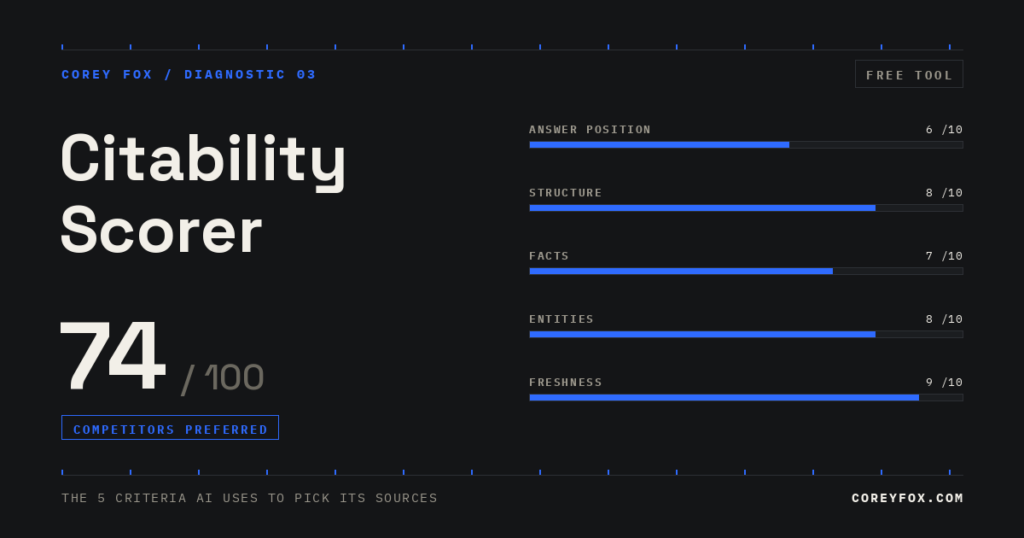
Citability Scorer
When AI answers a question in your category, it cites one or two sources and ignores everyone else. The Citability Scorer scores your page against the five criteria machines use to pick their sources, and shows exactly why you are or are not the citation.
Enter the page you want cited and the question a prospect would ask AI. The scorer reads the live page and grades it the way a language model selects sources: answer position, structure, factual density, entity clarity, and freshness.
Takes 15 to 40 seconds. The scorer fetches your live page, so score what is actually published.
The Citability Scorer is a free tool that reads any live page and scores it 0 to 100 against the five criteria AI systems weigh when choosing citation sources: answer positioning, structural clarity, factual density, entity coverage, and freshness.
Enter a URL and the query you want to win, and see exactly why AI does or does not cite you.
What is citability?
Citability is how likely an AI system is to select your page as a source when it answers a question. When ChatGPT, Perplexity, or Google AI Overviews compose an answer, they cite one or two pages and ignore the rest of the results.
Citability measures whether your page is built to be the one selected, relative to a specific query.
This is the metric that replaces rank position in AI search.
Ten pages can rank on a results page and share the clicks. An AI answer does not share.
It cites its sources and erases everyone else, which means the difference between citable and almost citable is the difference between being the answer and being invisible.
The five criteria and how they are weighted
| Criterion | Weight | What the scorer checks |
|---|---|---|
| Answer positioning | 30 percent | Is the core answer stated in the first 100 words as a direct 40 to 60 word paragraph, or buried? |
| Structural clarity | 25 percent | Do headings match query variations? Is data in tables and lists machines can extract? |
| Factual density | 20 percent | Specific numbers, dates, and evidence, or rehashed generalities anyone could write? |
| Entity coverage | 15 percent | Are key entities defined on first mention with explicit relationships? |
| Freshness signals | 10 percent | Dated content, current references, recent developments acknowledged? |
The weighting reflects how source selection actually behaves: models extract answers, so where and how the answer appears dominates everything else. A page can be beautifully written and score poorly, because the scorer is not grading prose. It is grading extractability.
To see what your page is competing against, pull the neutral top 100 for the keyword and check which answer blocks the query triggers.
What the score means
| Score | Band | What it tells you |
|---|---|---|
| 80 to 100 | Citation ready | Built the way models select sources. Defend the position and keep it fresh. |
| 50 to 79 | Competitors preferred | Close, and close loses. A better-structured page is taking your citation. |
| Below 50 | Invisible to AI | The page may rank in traditional results while never appearing in an AI answer. |
How to raise a citability score
- Move the answer to the top. A 40 to 60 word direct answer immediately after the main heading is the single highest-weight fix. The full report writes this paragraph for you.
- Restructure for extraction. Convert comparison prose into tables, processes into numbered steps, and add headings that mirror the questions people ask.
- Add facts only you can state. Original data, specific figures, and named methods get cited. Generic advice gets paraphrased without attribution.
- Define your entities. Name what things are on first mention and make relationships explicit, so models can map your page to the topic with confidence.
- Show freshness. Visible dates, current references, and acknowledgment of recent developments signal the page is maintained.
These moves are the on-page half of Answer Engine Optimization. The other half is the off-page record that makes models trust you enough to cite you.
If your score came back under 80 on a page that matters, book the free revenue audit or review the service tiers for what full citation engineering looks like.
Related instruments: measure what lost citations already cost you with the AI Overviews Revenue Leak Diagnostic, and check what AI says when prospects ask about your brand with the Brand Hallucination Auditor.
Frequently asked questions
Is the Citability Scorer free?
Yes. The score, verdict, and all five criterion scores are free with no signup. Your email unlocks the per-criterion assessments, the three highest-impact fixes, and a rewritten opening paragraph ready to paste. There is no paid version.
Why does the scorer need a target query?
Because citability does not exist in the abstract, a page is citable relative to a question, the same way models select sources relative to a prompt. The same page can score 85 for one query and 40 for another.
Does a high score guarantee AI will cite my page?
No. The score measures the on-page factors within your control. Citation also depends on your site's authority, the competition for that query, and each platform's retrieval behavior. A high score makes you eligible. Authority makes you chosen.
Can I score competitor pages?
Yes, any public URL. Scoring the page currently cited for your target query, then comparing its criterion scores to yours, shows precisely what the machines preferred about it.
My page ranks well on Google. Why did it score low?
Ranking and citability reward different structures. Traditional ranking tolerates the answer arriving in paragraph six. Answer engines extract, so a buried answer scores low on the heaviest criterion no matter how well the page ranks.
How often should I re-score a page?
After every meaningful edit, and quarterly for money pages even without changes. Freshness decays on its own, and competitors restructure their pages too. Re-scoring after implementing the fixes confirms the changes moved the number.