Internal Linking Architecture: The Growth Lever SEOs Forget
Last Updated on October 13, 2026 by Corey Fox
Direct Answer
Internal linking is the deliberate way pages on your site point to each other to establish priority, context, and flow.
It matters because internal links decide where authority accumulates, how crawlers move, and whether content actually performs or just exists.
Why This Piece Exists
Internal linking is one of those topics everyone claims to understand and almost no one executes well.
Most sites have internal links.
Very few have internal linking architecture.
That difference is why some sites compound quietly while others keep publishing and never quite break through. Internal linking is not maintenance work. It is structural. If the structure is wrong, everything built on top of it underperforms.
This piece is written for people who are past surface-level SEO and want leverage that actually moves results.
What Internal Linking Really Is
Internal linking is how you explain your site to machines and guide people through it at the same time.
Search engines do not interpret intent the way humans do. They look for signals. Links are one of the strongest signals available because they create relationships. Page to page. Topic to topic. Priority to priority.
When internal links are weak or accidental, search engines fill in the gaps. When they are intentional, you control the narrative.
Why Internal Linking Gets Undervalued
Internal linking suffers from a perception problem.
It does not feel like growth work.
It does not ship like content.
It does not look impressive like backlinks.
So it gets postponed.
Or delegated.
Or treated as something you do after publishing.
The irony is that internal linking often unlocks gains faster than either content or links, especially on sites that already have history. I have seen entire sections of sites wake up without a single new page being published.
That only happens when internal linking is treated like infrastructure.
How Search Engines Use Internal Links
Search engines use internal links to make sense of your site in very practical ways.
They use them to find pages.
They use them to decide which pages matter more.
They use them to infer what a page is about.
They use them to understand topic groupings.
They use them to decide where crawl resources go.
Every internal link you add affects at least one of those decisions. Usually more than one.
Authority Flow Without the Math
You do not need to calculate anything to understand authority flow.
Some pages on your site are stronger than others. That strength comes from age, links, engagement, or all three. Internal links determine whether that strength gets shared or trapped.
When strong pages do not link intentionally, authority stagnates. When they do, weaker pages gain relevance faster than they would on their own.
Internal linking does not create authority. It decides where it goes.
The Hub and Spoke Model Done Correctly
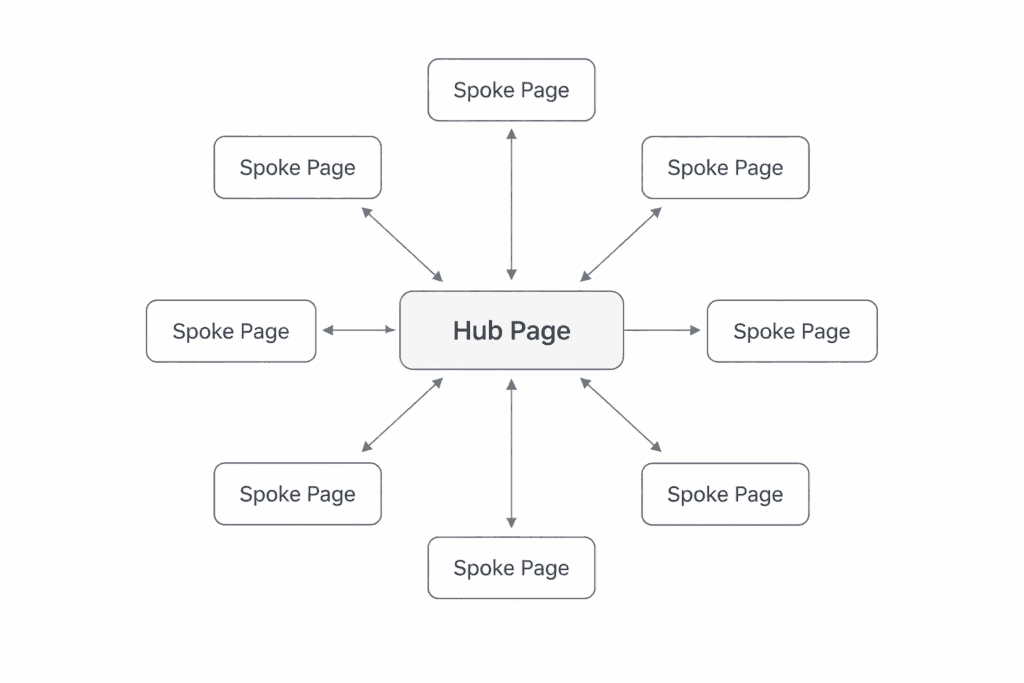
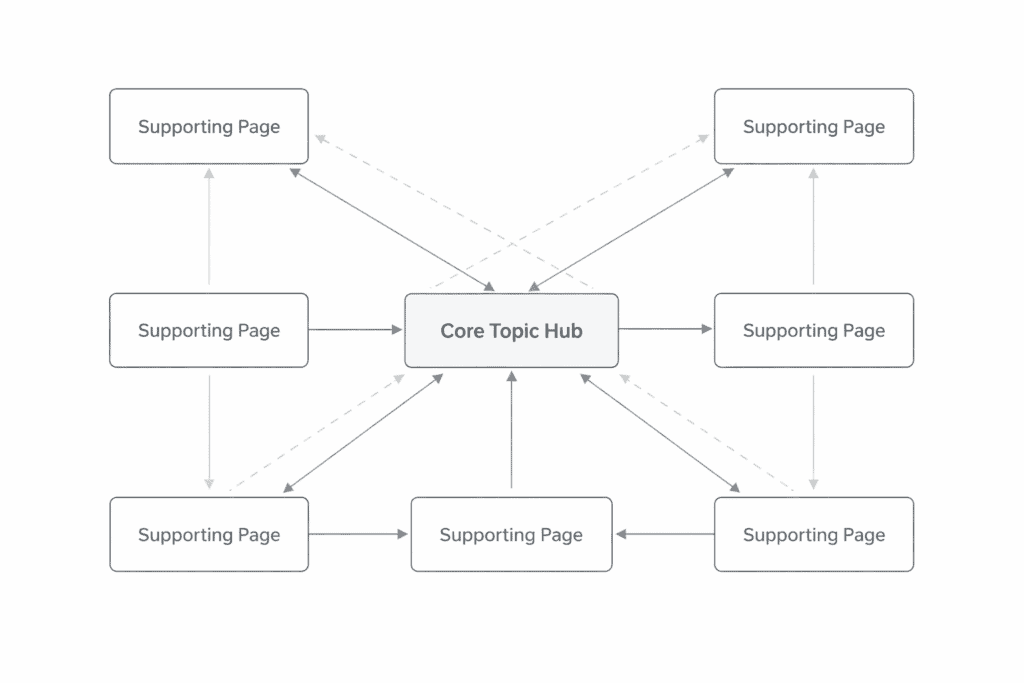
At the core of internal linking architecture is the hub and spoke model.
A hub page represents a broad topic.
Spoke pages represent specific subtopics.
This is not about word count. It is about role.
The hub frames the subject.
The spokes prove depth.
Every spoke should point back to its hub. That relationship tells search engines which page carries the most weight for the topic and which pages exist to support it.
What Breaks Most Hub Strategies
Most teams stop once spokes link to the hub.
That creates hierarchy, but it does not create authority density.
Strong sites also link laterally. Related spokes reference each other where it makes sense. This creates reinforcement instead of isolation.
A ladder explains structure.
A network proves expertise.
Search engines reward the network.
Contextual Links Matter More Than People Think
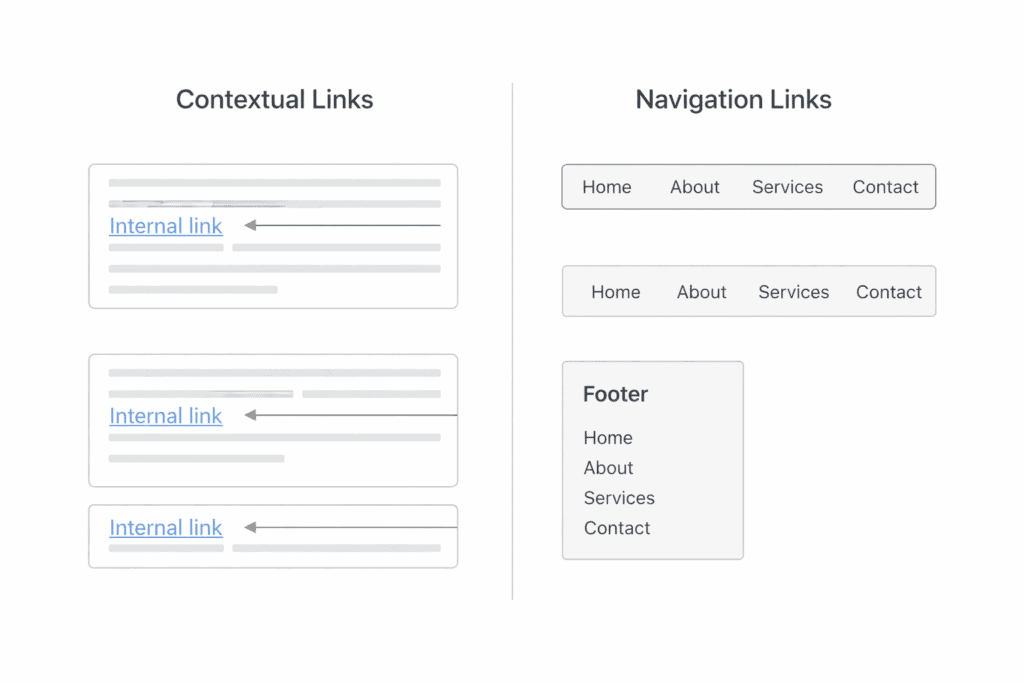
Links in navigation are necessary. They are not sufficient.
Contextual links carry meaning because they live inside sentences that explain why the relationship exists. Search engines pay attention to that context.
If most of your internal links live in menus or footers, your site is discoverable but not well understood.
That distinction matters more as search becomes more semantic.
Anchor Text Without the Games
Anchor text should sound like something a human would write.
If you are thinking about keyword ratios, you are already overthinking it. Describe where the link goes. That is enough.
When anchor text feels natural, it tends to perform better and age better.
Crawl Depth Is a Silent Constraint
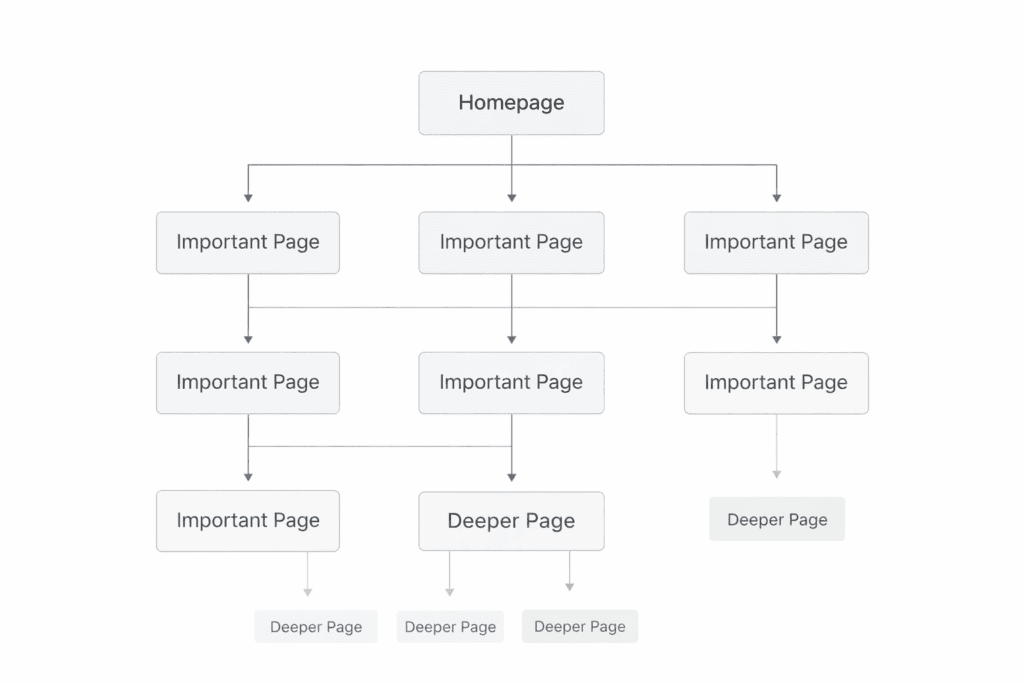
Pages buried deep in a site rarely perform the way they should.
They get crawled less.
They get refreshed less often.
They get treated as lower priority.
Internal linking is the simplest way to reduce crawl depth without touching design or navigation. Every contextual link is a shortcut. Too many sites leave important pages stranded simply because no one ever links to them.
Internal Linking as a Performance Multiplier
Internal linking does not replace other SEO work. It multiplies it.
Content performs better when it is supported.
Backlinks matter more when authority flows correctly.
Older pages resurface when they are reconnected.
This is why internal linking often produces results that feel disproportionate to the effort involved.
Internal Linking for Humans
Internal linking is also how you guide readers.
A good internal link answers a quiet question the reader has not asked yet. What should I look at next? What explains this further? Where do I go when I am ready to act?
When links do that well, engagement improves naturally. Search engines notice.
Moving Users Toward Decisions
Most sites link informational content to more informational content. High-performing sites link information to decisions.
Education leads to clarity.
Clarity leads to confidence.
Confidence leads to action.
Internal links are how you move someone through that progression without forcing it.
Treat Internal Linking Like a System
Internal linking works best when it has ownership.
A simple system looks like this.
Know what content exists.
Assign each page to one topic.
Designate a clear hub.
Link intentionally inside content.
Reinforce priority pages.
Revisit regularly.
When internal linking becomes procedural, results become repeatable.
Auditing Internal Links Properly
A real audit does not stop at broken links.
It looks at imbalance.
Which pages receive attention and which are ignored.
Where authority pools instead of flowing.
Which pages exist without context.
These issues are structural. Content alone will not fix them.
Common Mistakes That Hold Sites Back
Treating internal linking as an afterthought.
Relying only on navigation.
Ignoring older content.
Letting pages serve multiple roles.
Never revisiting links after publishing.
None of these break a site overnight. They just prevent it from scaling.
Internal Linking and AI Search
Search systems are moving toward synthesis. That makes structure more important, not less.
Clear topic relationships help machines summarize accurately.
Clear hierarchies help pages surface in broader answers.
Internal linking teaches machines what matters on your site. That is not changing.
How You Know It Is Working
When internal linking is done well, you see it.
Crawl patterns improve.
Older content resurfaces.
Secondary pages rank faster.
Performance becomes steadier.
These are not spikes. They are structural gains.
Frequently Asked Questions
Does internal linking still matter in 2026?
Yes, of course. It is one of the few ranking levers you control directly.
How many internal links should a page have?
There is no clean number. Most underperforming pages are simply underlinked and disconnected from the rest of the site.
Can internal linking replace backlinks?
No. It determines whether the backlinks you already earned actually help.
How often should internal links be reviewed?
Any time new content is added and any time performance stalls.
Final Takeaways
Internal linking is not decoration and it is not cleanup work. It shapes how a site grows and where it eventually stalls.
Hub pages concentrate authority.
Spoke pages justify it.
Contextual links create momentum.
When internal linking is weak, content works harder than it should. When it is intentional, growth becomes easier to sustain.
If you want predictable SEO results, this belongs in the foundation.