Best AI Visibility Tools (2026): What Actually Tracks Your Brand in ChatGPT
Last Updated on July 22, 2026 by Corey Fox
AI visibility tools track whether your brand appears in AI-generated answers across ChatGPT, Perplexity, Google AI Overviews, and other answer engines. They measure mentions, citations, share of voice against competitors, and which sources the engines pull from. Rankings tell you where Google puts you. Visibility tools tell you what AI says about you.
Here’s the problem with this category in 2026: it exploded. A dozen tools launched in eighteen months, they all claim to do the same thing, and half of them are a dashboard on top of the same API calls you could run yourself.
I use these tools daily for client work. Here’s the honest breakdown.
What “AI visibility” actually means
Three separate things get lumped under one label:
- Mentions. Does the AI name your brand in its answer?
- Citations. Does the AI link your site as a source?
- Share of voice. How often does it name you vs your competitors across a set of buyer prompts?
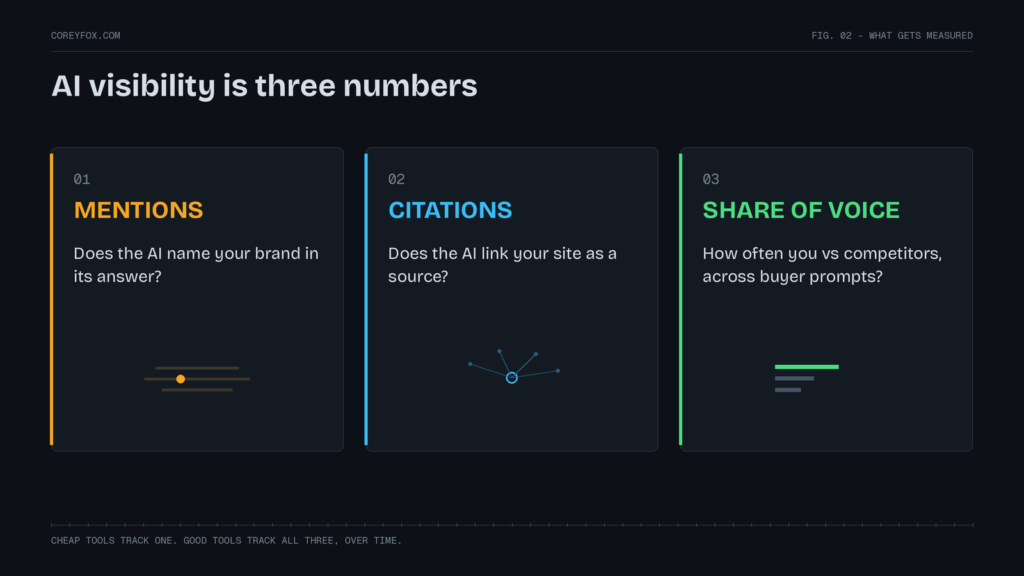
Cheap tools track one of these. Good tools track all three, across engines, over time. That distinction explains most of the price gap below. If the difference between mentions and citations is fuzzy, read AEO vs GEO first, because it’s the same split.
The tools
1. Profound
The enterprise standard. Tracks brand mentions and citations across ChatGPT, Perplexity, Gemini, and AI Overviews, with prompt-level share of voice and the source pages driving each answer. Built for brands with a real budget and a team to act on the data.
Best for: mid-market and enterprise with $1K+/mo for monitoring alone. Weakness: overkill if you have 20 prompts to track. [ADD: your test screenshot]
2. Ahrefs Brand Radar
Lives inside Ahrefs, which you probably already pay for. Tracks mentions, citations, and share of voice in AI answers, and ties it to the same index you use for SEO. The practical choice if you want AI visibility next to your keyword data instead of in a separate tab.
Best for: teams already on Ahrefs. Weakness: engine coverage is narrower than dedicated tools. [ADD: your test note]
3. Semrush AI Toolkit
Same logic as Brand Radar, Semrush flavor. Tracks AI Overview presence for your keywords plus brand perception across LLMs. Fine if Semrush is your daily driver.
Best for: Semrush shops. Weakness: AI features feel bolted on rather than native.
4. Otterly.AI
The mid-market workhorse. Monitors prompts across ChatGPT, Perplexity, and AI Overviews, tracks brand mentions, link citations, and sentiment. Priced for small teams, simple to set up, does the job without the enterprise ceremony.
Best for: SMB and mid-market getting started, roughly $30-300/mo. Weakness: no deep source analysis. You see that you lost, not always why.
5. Peec AI
Strong share-of-voice tracking with clean competitor benchmarking. Popular with agencies because the reporting exports look client-ready out of the box.
Best for: agencies reporting to clients. Weakness: pricier per tracked prompt than Otterly.
6. HubSpot AI Search Grader
Free. Enter your brand, get a snapshot of how ChatGPT perceives it, sentiment, and share of voice in your category. It’s a lead magnet, so the depth ends where the sales call begins, but as a free first look it’s legitimate.
Best for: a zero-cost baseline. Weakness: snapshot, not monitoring. No tracking over time.
7. My free checkers
I built two free tools for exactly the first step of this work: the AI Citation Checker shows which engines cite your domain for your category questions, and the Citability Scorer grades whether a page is structured so an AI can lift and attribute your answer. No signup wall. They’re the diagnostic layer; the paid tools above are the monitoring layer.
Which one should you pick?
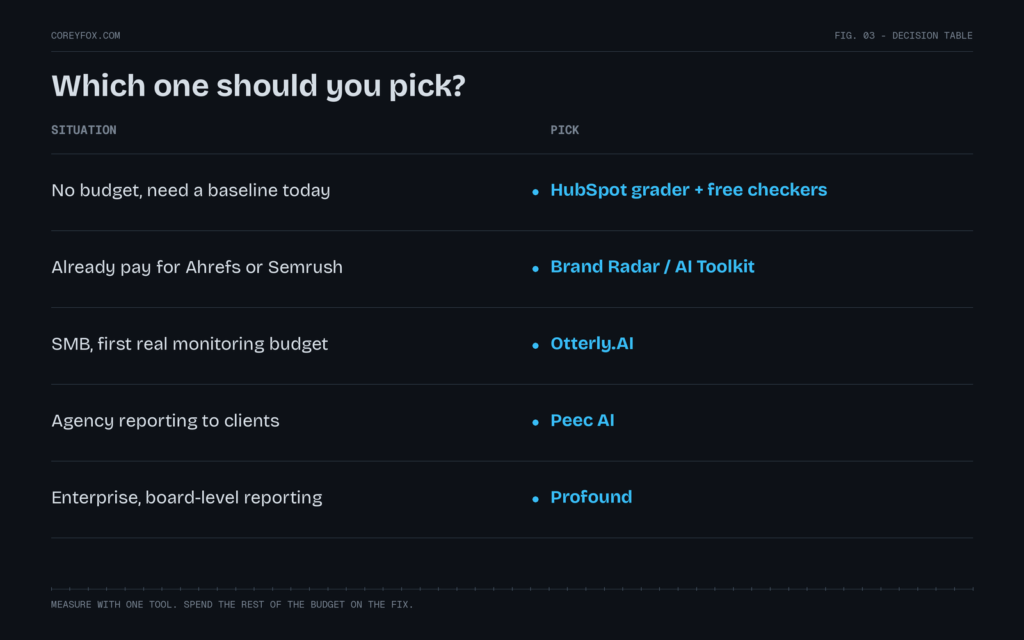
| Situation | Pick |
|---|---|
| No budget, need a baseline today | HubSpot grader + my free checkers |
| Already pay for Ahrefs or Semrush | Brand Radar / AI Toolkit |
| SMB, first real monitoring budget | Otterly.AI |
| Agency reporting to clients | Peec AI |
| Enterprise, board-level reporting | Profound |
The uncomfortable truth about all of them
Every tool on this list measures the problem. None of them fix it.
If the dashboard shows your competitor cited 40 times and you cited twice, the fix is schema, entity definitions, answer-block content structure, and coverage on the sources AI engines trust. That’s AEO work. Buying a second monitoring tool doesn’t move the number.
Measure with one tool. Spend the rest of the budget on the fix.
FAQs
What is AI visibility? AI visibility is how often and how favorably your brand appears in AI-generated answers, measured across mentions, citations, and share of voice against competitors.
Are free AI visibility checkers accurate? For a point-in-time snapshot, yes. What free tools can’t do is track drift over weeks, which is where paid monitoring earns its fee. AI answers change constantly; a snapshot ages in days.
How many prompts should I track? Start with 20 to 30: your money queries phrased the way a buyer would ask an assistant, not the way they’d type into Google. “Best inventory software for a 50-store Shopify brand,” not “inventory software.”
Do these tools improve my visibility? No. They measure it. Improving it is structural work on your site and reputation work off it. If the gap between those two is unclear, this is the breakdown.
Want to know what your current AI visibility gap costs in dollars? Get the free revenue audit. 8 minutes of analysis, a 20-minute call, no pitch.