AEO vs GEO: What’s the Difference (And Do You Need Both)?
Last Updated on October 13, 2026 by Corey Fox
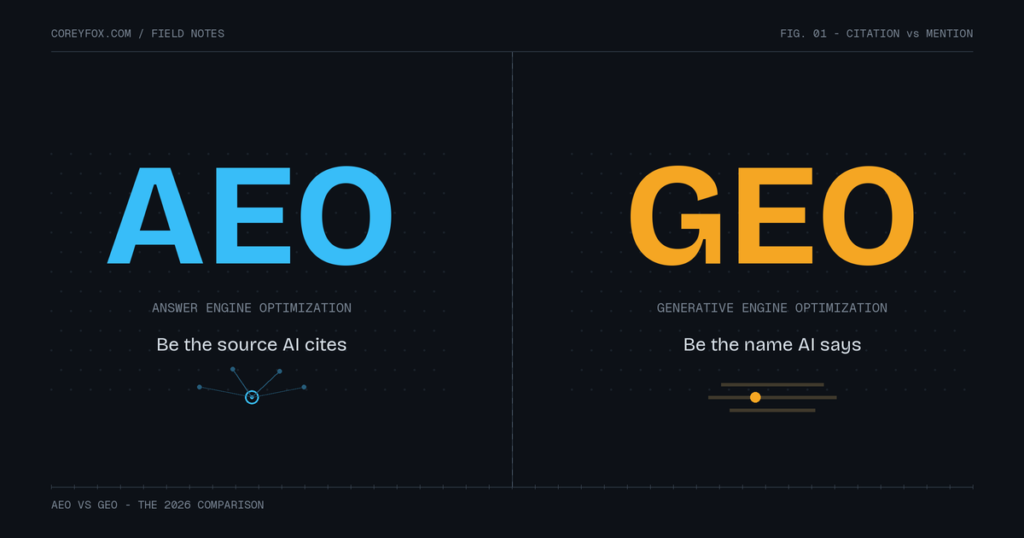
AEO (Answer Engine Optimization) is the practice of structuring content so AI engines cite your brand as the source when answering a question. GEO (Generative Engine Optimization) is the practice of influencing what AI engines say in the generated answer itself. AEO earns you the citation link. GEO earns you the mention inside the text. Most brands need both, in that order.
That’s the short version. Here’s why the industry keeps confusing the two, and why it matters for your pipeline.
Two acronyms, one problem
Both terms exist because the same thing happened: your buyer stopped clicking ten blue links and started asking ChatGPT, Perplexity, and Google AI Overviews for a recommendation.
The industry responded by inventing acronyms faster than definitions. I’ve seen agencies use AEO and GEO interchangeably in the same pitch deck. They are not the same work.
AEO is about being the source. When Perplexity answers “best inventory software for Shopify stores” and lists three citations on the right, AEO is the work that puts your URL in those citations. The mechanics are technical: schema markup, direct answer blocks, entity definitions, content structured so a machine can lift your answer and attribute it to you.
GEO is about being in the answer. When ChatGPT writes “popular options include X, Y, and Z,” GEO is the work that gets your brand into that sentence, whether or not a citation appears. The mechanics lean on entity authority: consistent brand mentions across the sources the model trusts, third-party reviews, comparison pages on other people’s sites, presence in the training data and the retrieval layer.
The comparison
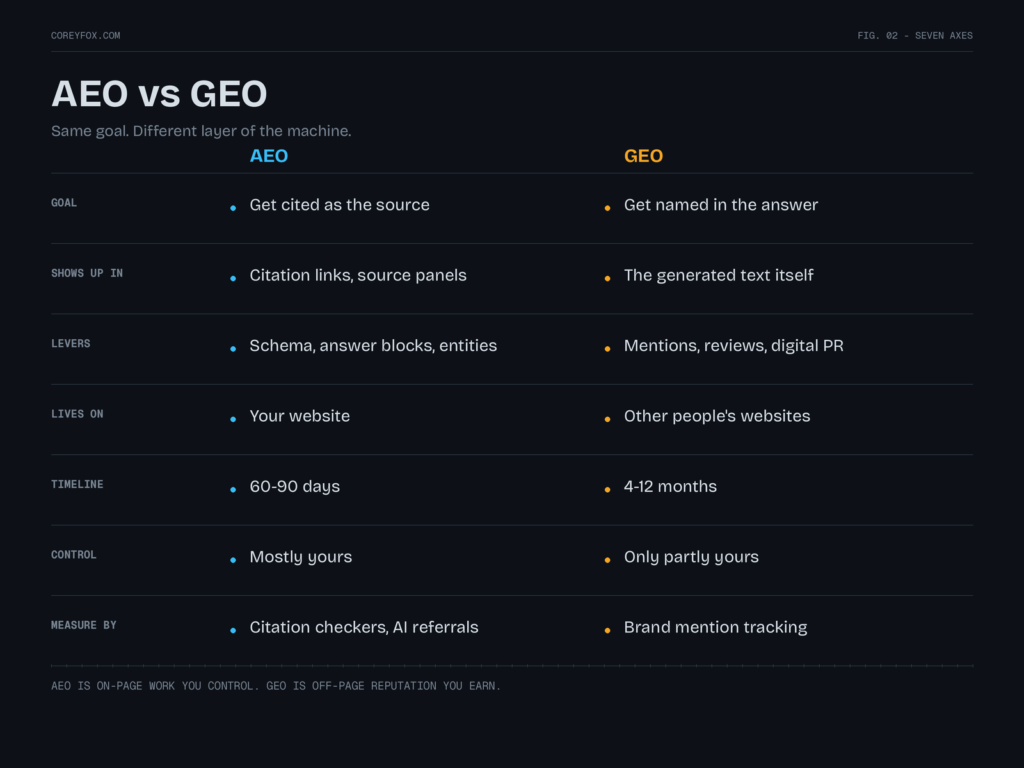
| AEO | GEO | |
|---|---|---|
| Goal | Get cited as a source | Get named in the generated answer |
| Where it shows up | Citation links, source panels | The answer text itself |
| Primary levers | Schema, answer blocks, page structure, entities | Brand mentions, third-party coverage, reviews, digital PR |
| Lives on | Your website | Mostly other people’s websites |
| Timeline | 60-90 days | 4-12 months |
| You control it | Mostly yes | Only partly |
| Measurable via | Citation checkers, referral traffic from AI engines | Brand mention tracking across engines |
One line to remember: AEO is on-page work you control. GEO is off-page reputation you earn.
Which one first?
AEO first. Every time.
Here’s the reason. GEO without AEO gets you mentioned but not clicked. The engine names your brand, the buyer asks a follow-up, the engine pulls from whatever source is best structured, and that source is your competitor’s comparison page. You did the hard reputation work and handed the click to someone else.
AEO is also faster and cheaper. It’s your own site. You can ship schema, rewrite answer blocks, and fix entity definitions in weeks. GEO requires other publications to write about you, and no consultant can promise you that on a deadline.
The sequence that works:
- AEO foundation. Schema, entity definitions, direct answer blocks on your money pages. 30-60 days.
- Measure. Run your pages through a citability scorer and check where you already appear in AI answers.
- GEO layer. Digital PR and third-party coverage aimed at the specific publications AI engines already cite in your category.
Where SEO fits
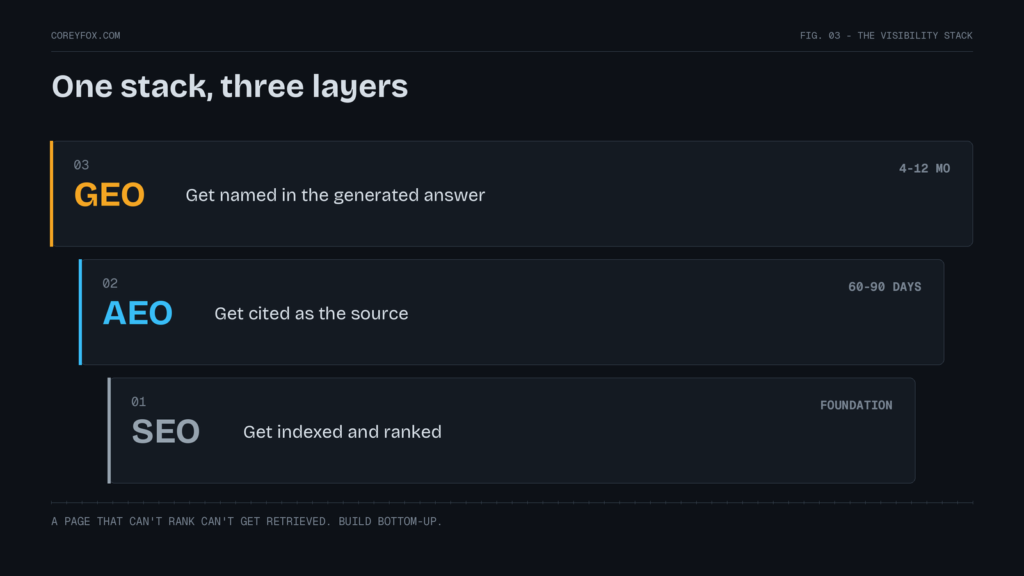
Neither replaces SEO. Google still drives the majority of discovery, and AI Overviews are built on top of Google’s index. A page that can’t rank also can’t get retrieved. Think of it as one stack: SEO gets you indexed and ranked, AEO gets you cited, GEO gets you named. I covered the full picture in What is AEO.
FAQs
Is GEO just digital PR with a new name? Mostly, yes, plus measurement. The work is earning brand mentions on sources AI engines trust. What’s new is that you can now measure which engines mention you and which sources they pull from, and target the gap.
Can I do AEO without touching GEO? Yes, and for most mid-market brands it’s the right first move. If your category is low-competition in AI answers, AEO alone can make you the default citation.
Do AI engines actually send traffic? Yes. Perplexity and ChatGPT both link citations, and referral traffic from AI engines converts at a higher rate than organic in most accounts I’ve seen, because the buyer arrives pre-answered and ready to act.
How do I know if I’m already cited? Run your category questions through my free AI Citation Checker. Takes two minutes and shows you which engines cite you and which cite your competitors.
Want the dollar figure on what AI search is costing you right now? Get the free revenue audit. 8 minutes of analysis, a 20-minute call, no pitch.