AI SEO Statistics 2026: 56 Verified Numbers on AI Search, Traffic and AEO
Last Updated on October 27, 2026 by Corey Fox
AI answers now sit between your customers and your website. Below are 56 statistics on how big AI search has become, what it does to clicks, how AI engines pick sources, and how often they get brands wrong. I checked every number against the original study.
Key statistics
- 900 million+ people use ChatGPT every week (OpenAI, 2026).
- 1 billion+ people use Google’s AI Mode every month (Google, 2026).
- 8% of Google visits with an AI summary led to a click on a regular result, compared with 15% without one (Pew Research Center, 2025).
- 58% lower click-through rate for the #1 ranking page when an AI Overview shows up (Ahrefs, 2026).
- 68% of US Google searches ended without a click in early 2026 (SparkToro, 2026).
- 92% to 94% of Google AI Mode searches are zero-click (Semrush, 2025).
- 60% higher conversion rate for AI-referred visitors to US retail sites compared with other traffic (Adobe, 2026).
- 38% of AI Overview citations come from pages in Google’s top 10, down from about 76% in mid-2025 (Ahrefs, 2026).
- 75% of brands that reviewed at least 20 AI-generated facts about themselves found at least one false fact (Searchable, 2026).
- 94% of enterprises plan to increase AEO/GEO investment in 2026 (Conductor, 2026).
AI search adoption statistics
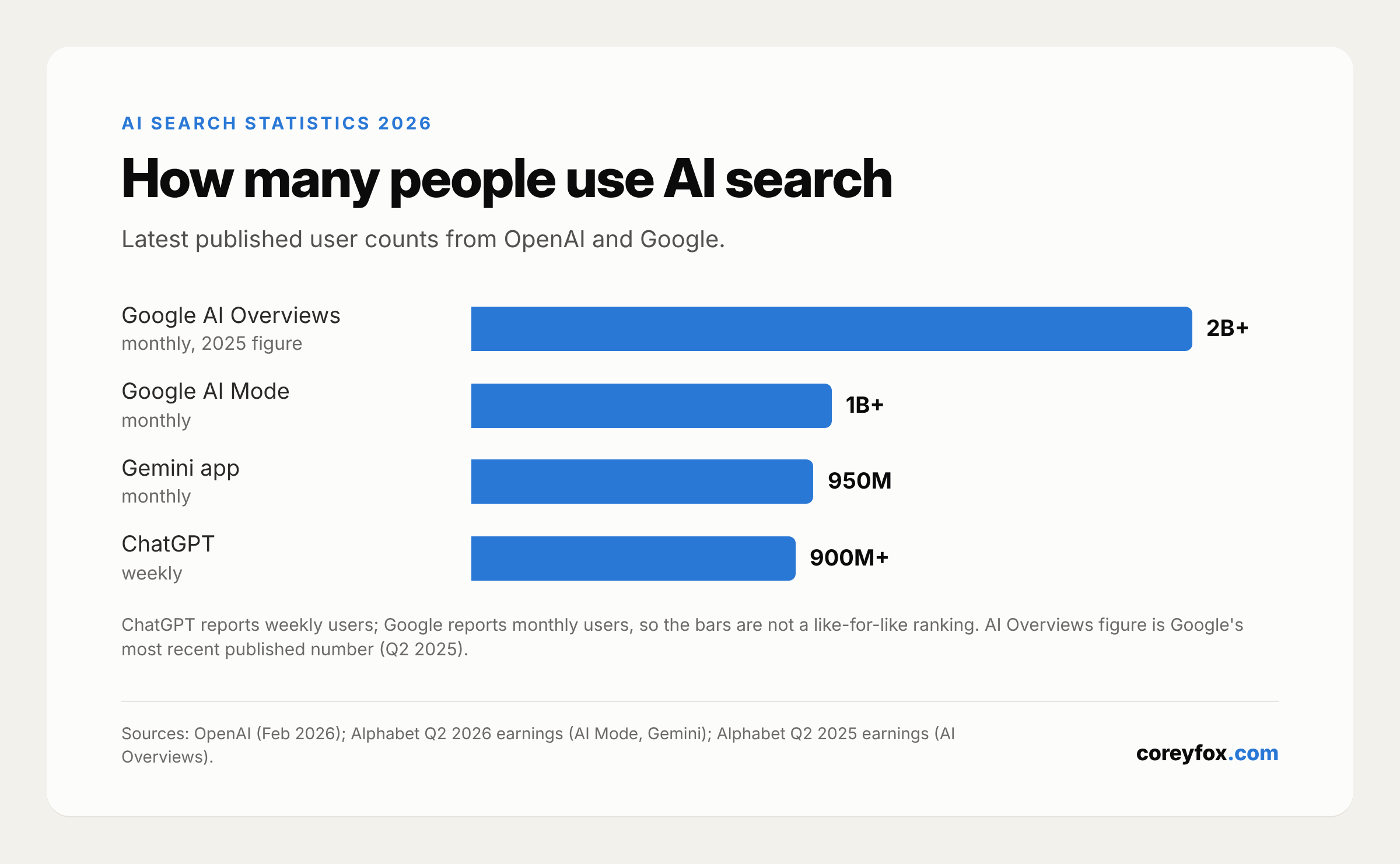
The user base for AI answers is now measured in billions, and it’s no longer just ChatGPT.
- 900 million+ weekly active ChatGPT users and 50 million+ consumer subscribers as of February 2026 (OpenAI, 2026).
- 2.5 billion+ messages sent to ChatGPT per day, about 29,000 per second, as of July 2025 (OpenAI usage paper, 2025).
- 24% of ChatGPT usage was “Seeking Information” by July 2025, up from 14% a year earlier. That’s search behavior moving into a chat window (OpenAI usage paper, 2025).
- 73% of ChatGPT messages were non-work in June 2025, up from 53% in June 2024 (OpenAI usage paper, 2025).
- 1 billion+ monthly active users for Google AI Mode as of Q2 2026 (Google, 2026).
- 950 million monthly active users for the Gemini app as of Q2 2026 (Google, 2026).
- 2 billion+ monthly users for AI Overviews across 200+ countries and territories, as of Google’s last published figure (Google, 2025).
- 780 million Perplexity queries in May 2025, per CEO Aravind Srinivas (Search Engine Land, 2025).
- 44% of US adults say they use ChatGPT, up from 18% in 2023. Among adults 18 to 29, it’s 61% (Pew Research Center, 2026).
- 53% ChatGPT share of AI chatbot web traffic in May 2026, down from about 76% in June 2025. Gemini rose from under 9% to about 27% over the same period (Similarweb, 2026).
AI referral traffic and conversion statistics
AI still sends a small share of visits. The visits it does send tend to be worth more.
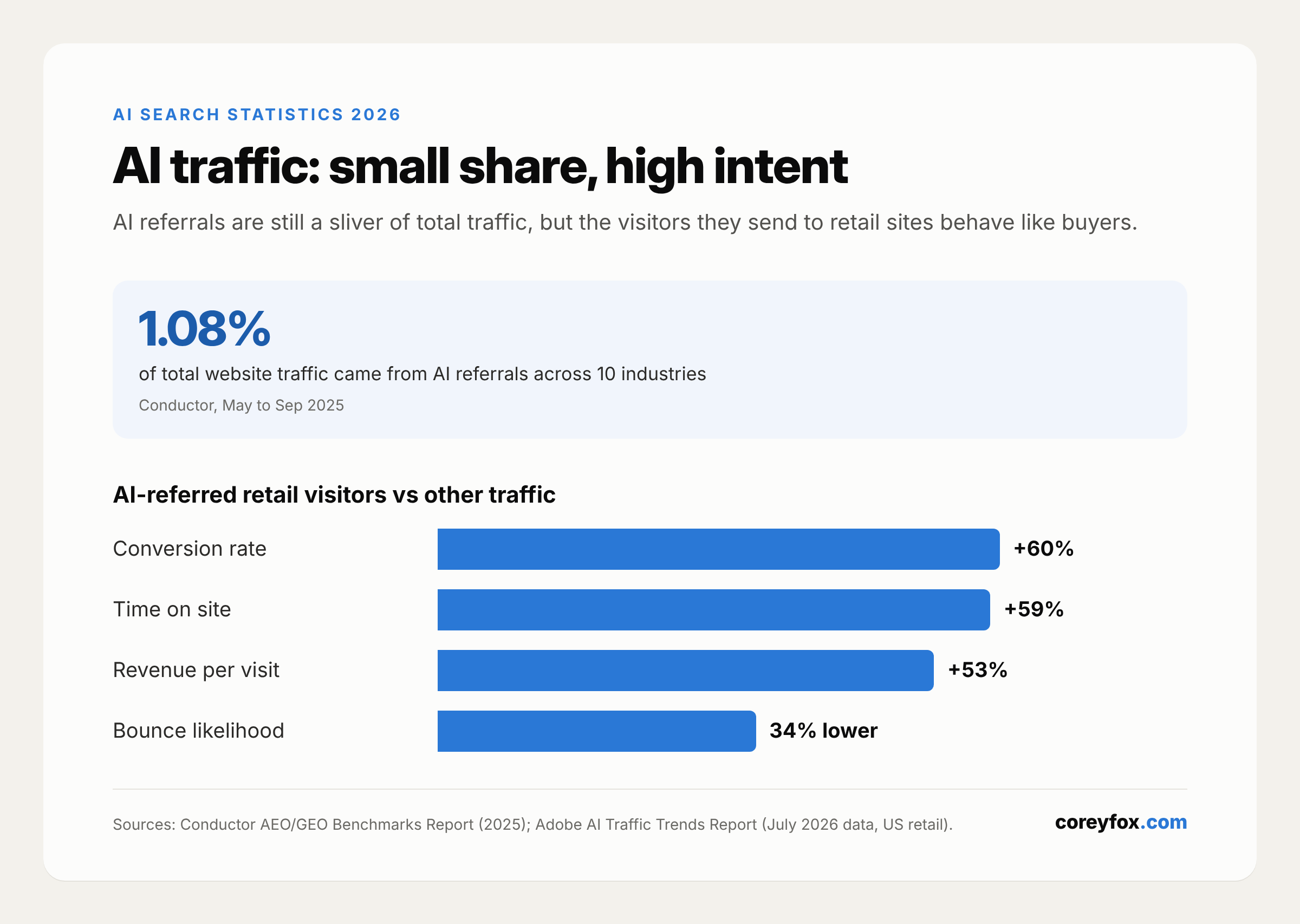
- 1.08% of total website traffic came from AI referrals across 10 industries, May to September 2025 (Conductor, 2025).
- 87.4% of AI referral traffic came from ChatGPT on average (Conductor, 2025).
- 693% year-over-year growth in generative AI traffic to US retail sites during the 2025 holiday season (Adobe, 2026).
- 60% higher conversion rate for AI-referred retail visitors versus non-AI traffic in July 2026. A year earlier, AI traffic was the weaker converter (Adobe, 2026).
- 53% more revenue per visit from AI-referred retail traffic than non-AI traffic in July 2026 (Adobe, 2026).
- 59% longer time on site and 34% lower likelihood of bouncing for AI-referred retail visitors (Adobe, 2026).
- 9x higher conversion for holiday shoppers referred from AI search compared with shoppers referred from social media (Salesforce, 2026).
- $262 billion in 2025 holiday online sales (20% of the total) was influenced by AI and agents (Salesforce, 2026).
- 4.4x the value of an average organic search visitor, measured by conversion rate, for the average AI search visitor (Semrush, 2025).
- 12.1% of Ahrefs signups came from AI search, which drove just 0.5% of its traffic (Ahrefs, 2025).
- Under 0.2% of all traffic to 973 ecommerce sites came from LLMs, and that traffic converted below every traditional channel except paid social. This is the main counterpoint to the vendor data above (Kaiser and Schulze, Marketing Science, 2026).
Zero-click and AI Overview CTR statistics
When an AI answer appears, fewer people click through. Every major dataset agrees on that, even where the exact numbers differ.
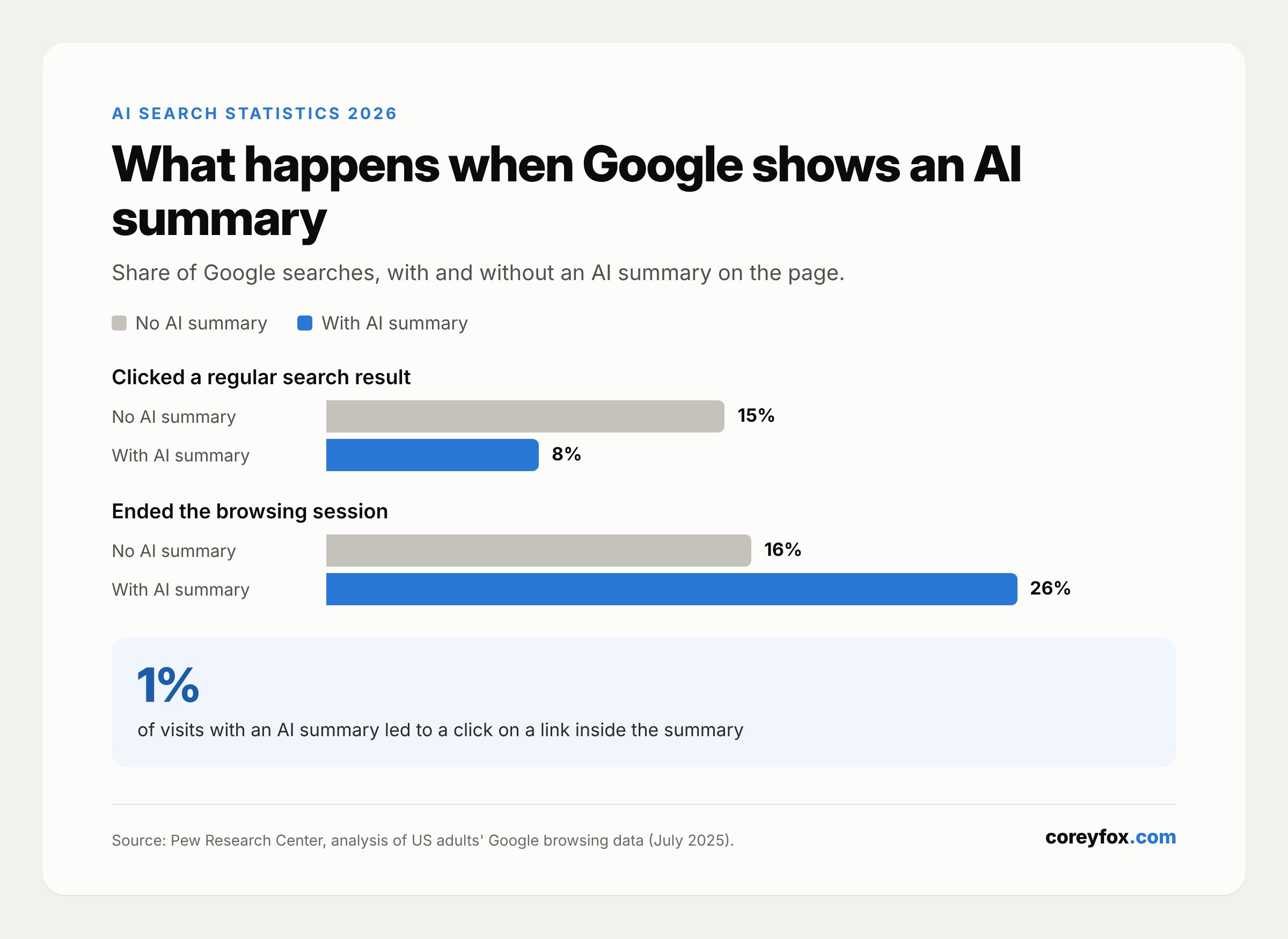
- 8% of Google visits with an AI summary led to a click on a traditional result, compared with 15% of visits without one (Pew Research Center, 2025).
- 1% of visits to a results page with an AI summary included a click on a link inside the summary (Pew Research Center, 2025).
- 26% of searches with an AI summary ended the browsing session entirely, compared with 16% of searches without one (Pew Research Center, 2025).
- 58% lower average CTR for the #1 result when an AI Overview is present, based on 300,000 keywords (Ahrefs, 2026).
- 61% drop in organic CTR on queries with AI Overviews, from 1.76% to 0.61%, between June 2024 and September 2025. Paid CTR on the same queries fell 68% (Seer Interactive, 2025).
- 68.01% of US Google searches ended without a click from January to April 2026, up from 60.45% in 2024 (SparkToro, 2026).
- 92% to 94% of Google AI Mode searches ended with no visit to an outside website (Semrush, 2025).
- 80% of consumers rely on zero-click results for at least 40% of their searches, which Bain estimates cuts organic traffic by 15% to 25% (Bain & Company, 2025).
- 13.94% of keywords triggering AI Overviews were transactional by late 2025, up from 1.98% in October 2024. AI Overviews are moving into shopping queries (Semrush, 2025).
- 25.11% of US Google searches triggered an AI Overview in Conductor’s dataset, ranging from 48.75% in health care to 4.48% in real estate (Conductor, 2025).
How AI engines choose what to cite
Ranking on Google helps, but it matters less than it did a year ago. Brand mentions across the web and community sites like Reddit carry real weight.
- 38% of URLs cited in AI Overviews also rank in Google’s top 10, down from about 76% in July 2025. Another 31% come from pages outside the top 100 (Ahrefs, 2026).
- 12% of URLs cited by AI assistants rank in Google’s top 10 for the original prompt. For ChatGPT it’s about 8%, for Perplexity 28.6% (Ahrefs, 2025).
- ~90% of the time, pages cited by ChatGPT search rank in position 21 or lower for related queries (Semrush, 2025).
- 0.664 correlation between branded web mentions and AI Overview brand visibility, compared with 0.218 for backlink count, across 75,000 brands (Ahrefs, 2025).
- 47.9% of ChatGPT’s top-10 cited sources were Wikipedia, and 46.7% of Perplexity’s were Reddit. Across all ChatGPT citations, Wikipedia’s share was 7.8% (Profound, 2025).
- Reddit was the single most-cited domain across ChatGPT, AI Mode, Gemini, Perplexity and AI Overviews in a 30-million-citation US analysis, ahead of YouTube, LinkedIn and Wikipedia (Peec AI, 2026).
- ~60% to ~10%: the share of ChatGPT responses citing Reddit fell from close to 60% in early August 2025 to around 10% by mid-September 2025. Citation sources can shift fast (Semrush, 2025).
- 5% to 10% of the sources AI search references are brands’ own websites (McKinsey, 2025).
- 17.99% of AI citations in the consumer staples category went to amazon.com, the top cited domain in that industry (Conductor, 2025).
- 35% higher organic CTR for brands cited in an AI Overview compared with brands that weren’t cited on the same type of query (0.70% vs 0.52%) (Seer Interactive, 2025).
Consumer trust and AI shopping statistics
Shoppers use AI for research and still check the brand’s site before buying.
- 50% of US consumers use AI-powered search, and 44% of those users call it their primary source of insight for buying decisions (McKinsey, 2025).
- $750 billion in US revenue is projected to flow through AI-powered search by 2028 (McKinsey, 2025).
- 42% of US consumers have used AI assistants for online shopping, up 4 points since March 2026 (Adobe, 2026).
- 66% of AI shoppers visit a brand’s website to verify an AI recommendation, and 89% click links the AI provides (Adobe, 2026).
- 77% of AI shoppers feel more confident in a purchase after using an AI assistant, and 69% say they’re less likely to return it (Adobe, 2026).
- 53% of consumers distrust AI-powered search results, and 61% want an option to turn AI summaries off (Gartner, 2025).
Marketer adoption of AEO and GEO
Budgets are moving, though most adoption data comes from vendors that sell AEO tools. Keep that in mind.
- 94% of enterprise marketing leaders plan to increase AEO/GEO investment in 2026, and 97% say it already had a measurable positive impact in 2025 (Conductor, 2026).
- 12% of digital marketing budgets went to AEO/GEO on average at enterprises in 2025 (Conductor, 2026).
- 37.7% of marketers plan to increase spending on AI chatbots such as ChatGPT, Perplexity, Gemini and Claude (HubSpot, 2026).
- 25% drop in traditional search engine volume by 2026 was Gartner’s 2024 prediction. SparkToro’s 2026 data shows clicks falling faster than searches (Gartner, 2024).
AI hallucinations and brand misrepresentation
Getting cited is half the job. The other half is making sure the AI says true things about you.
- 45% of AI assistant answers about news had at least one significant issue, and 31% had serious sourcing problems, across 3,000+ responses in 18 countries (EBU and BBC, 2025).
- 76% of Gemini’s news answers had significant issues, more than double the other assistants tested (EBU and BBC, 2025).
- 9.2% of 32,556 AI-generated facts about 1,704 brands were marked false by the brands themselves. Perplexity (11.5%) and Google AI Overviews (11.4%) had the highest error rates (Searchable, 2026).
- 31.2% of branded prompts got no answer at all from AI engines. When they did answer, 2.8% of responses had errors, with AI Overviews highest at 5.7% (Seer Interactive, 2026).
- 37% to 39% of Gemini and Perplexity answers repeated planted misinformation about a fictional brand, compared with under 7% for ChatGPT, in a small controlled test (Ahrefs, 2025).
What this means for ecommerce brands
Here’s how I read this data for Shopify and DTC stores.
- Don’t judge AI by traffic share. AI is around 1% of visits, but Adobe’s retail data shows it converting 60% better. Set up a GA4 channel group for AI referrers so you can see that traffic on its own. Most Shopify stores I audit lump it into “Referral” and never look at it.
- Your product pages need to be readable by machines. AI engines pull from structured, consistent data. Clean Product, Offer, Review and Organization schema (with no duplicate or conflicting markup from apps) is the cheapest fix most stores can make. That’s what the Shopify Schema Kit is built for.
- Win off your site, not just on it. Brand mentions correlate with AI visibility three times more strongly than backlinks, and brands’ own sites make up only 5 to 10% of AI sources. Reddit threads, review sites, roundups and retailer listings are where AI forms its opinion of you.
- Check what AI says about you. With 75% of brands finding at least one false fact, assume something is wrong. Ask ChatGPT, Gemini, Perplexity and AI Mode about your pricing, shipping, return policy and best-sellers, then fix the source pages they cite. My free Brand Hallucination Auditor runs that check for you.
- Make your site the place shoppers verify. 66% of AI shoppers go to the brand’s site to confirm a recommendation. Clear specs, real reviews, and answers to obvious questions on the product page close that loop.
- Keep doing SEO. Most citation and conversion studies still show ranking pages, authority and indexation as the base layer. AEO sits on top of good technical SEO. It doesn’t replace it.
FAQ
How many people use AI search in 2026?
ChatGPT has more than 900 million weekly users (OpenAI, February 2026), Google’s AI Mode has more than 1 billion monthly users, and the Gemini app has 950 million monthly users (Google, Q2 2026).
Do AI Overviews reduce website traffic?
Yes. Pew found users clicked a regular result on 8% of visits with an AI summary versus 15% without, and Ahrefs measured a 58% lower CTR for the top-ranking page when an AI Overview appears.
Does AI search traffic convert better than organic?
In most vendor data, yes: Adobe found AI-referred retail visitors converted 60% better than other traffic in July 2026. A peer-reviewed study of 973 ecommerce sites found LLM traffic converted below most traditional channels, so test it on your own store.
What percentage of AI citations come from Google’s top 10?
About 38% of AI Overview citations come from top-10 pages (Ahrefs, 2026), and only about 12% of URLs cited by AI assistants rank in the top 10 for the original prompt (Ahrefs, 2025).
How accurate are AI answers about brands?
Brands marked 9.2% of AI-generated facts about themselves as false, and 75% of brands that reviewed at least 20 facts found at least one error (Searchable, 2026).
Methodology and sources
I collected these statistics in October 2026. Every number links to the page where I found it, and I checked each one against that page. I used primary sources wherever I could: the company, research group or publication that produced the data. The one exception is Perplexity’s query count, which comes from a news report of the CEO’s public remarks. I favored 2025 and 2026 data and labeled the year on every stat. The AI Overviews user figure is from 2025 because Google hasn’t published a newer one.
Some caveats. Many AI search studies come from companies that sell SEO or AEO software (Ahrefs, Semrush, Conductor, Seer, Searchable, Profound, Peec), so I note sample sizes and dates and point to independent research (Pew, the EBU/BBC study, Marketing Science) where it exists. Weekly and monthly user counts are not directly comparable. Zero-click figures differ by panel and method, so compare trends within a single source rather than across sources.
Found an error or a newer figure? Get in touch through my contact page and I’ll update it.