Ecommerce Site Search Statistics (2026): 45+ Data Points
Last Updated on October 27, 2026 by Corey Fox
Site search is where your highest-intent shoppers tell you exactly what they want, and most stores still fumble the answer. I pulled the most citable 2024 to 2026 data on on-site search, failed searches, AI shopping assistants, and where product searches start, with every number linked to the page it came from.
Key statistics
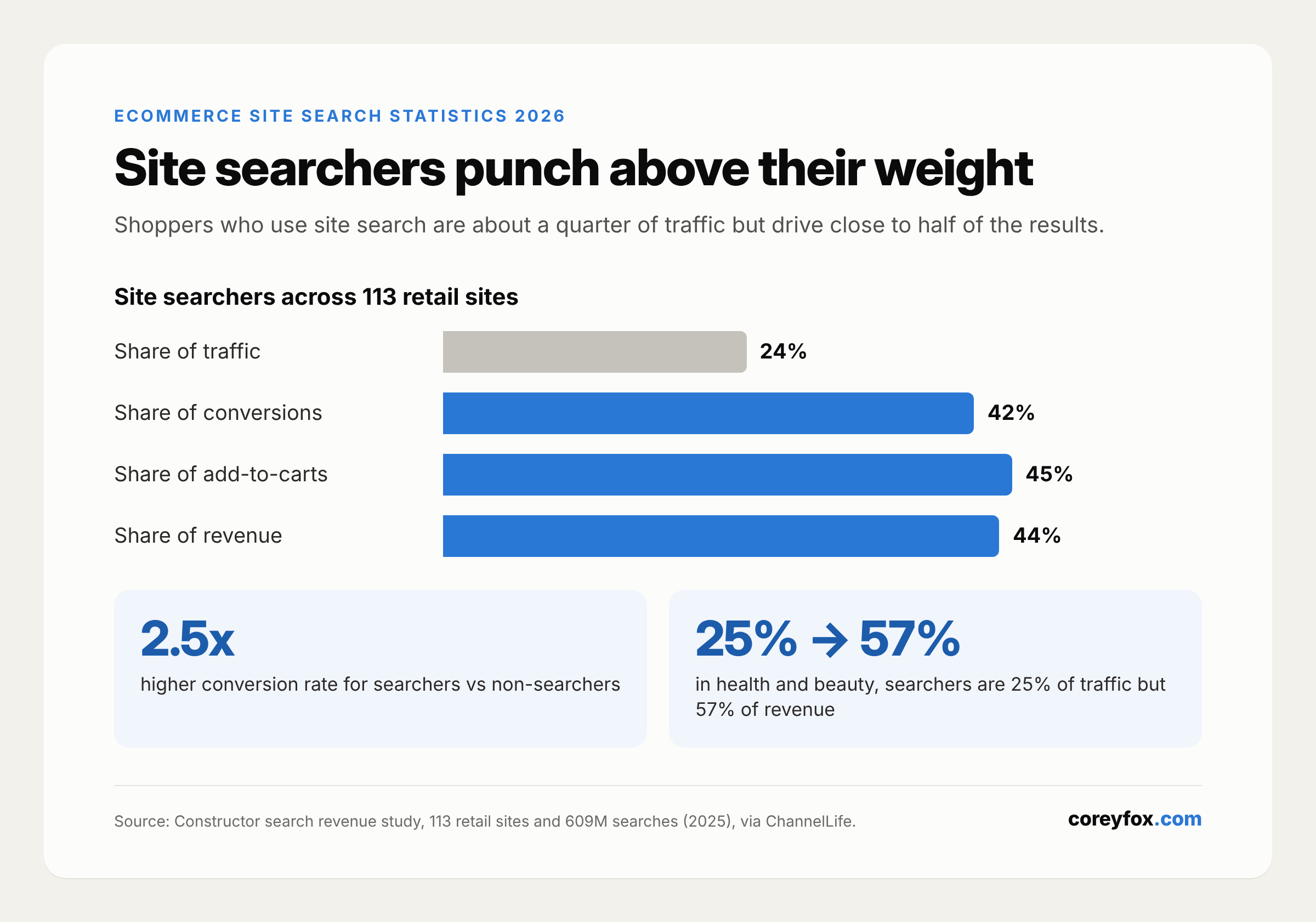
- Shoppers who use site search are 24% of ecommerce traffic but drive 44% of revenue (Constructor, 2025)
- Searchers convert at 2.5x the rate of non-searchers (Constructor, 2025)
- 56% of ecommerce sites fail to adequately support users’ search needs (Baymard Institute, 2026)
- 72% of consumers leave an ecommerce site when they can’t quickly find what they need, and 53% of them go to Google next (Coveo, 2025)
- 66% of shoppers have abandoned a retailer’s site for Amazon (Constructor & Shopify, 2025)
- 48% of shoppers say it takes at least 3 minutes to find what they need in on-site search results (Constructor & Shopify, 2025)
- If forced to choose, 41.4% of US and UK consumers would shop through AI, versus 38% who would shop directly on a brand’s site (Bloomreach, 2026)
- Generative AI traffic to US retail sites grew 693.4% year over year in the 2025 holiday season (Adobe, 2026)
- 19% of US adults (about 49.6 million people) now begin retail product research with AI (PYMNTS Intelligence, 2026)
- Amazon says shoppers who use its Rufus assistant are 60% more likely to complete a purchase (Fortune, 2025)
How many shoppers use site search
Estimates vary a lot by vertical and by how a vendor defines a “search session,” so cite the source and sample with the number.
- Roughly half of Baymard’s usability test participants turn to search as their preferred product-finding strategy (Baymard Institute, 2026)
- Searchers make up 24% of ecommerce traffic across 113 retail sites and 609 million searches (Constructor, 2025)
- 16% of online shoppers use site search, across six retail verticals (Prefixbox, 2024)
- 34% of test participants used the search field to look for non-product content like returns or shipping info (Baymard Institute, 2026)
- Algolia processed 33.5 billion search queries over Cyber Weekend 2025, up 13% year over year (Algolia, 2025)
Site search conversion rate and revenue
- Searchers convert at 2.5x the rate of non-searchers (Constructor, 2025)
- Searchers drive 44% of total site revenue, 42% of conversions, and 45% of add-to-cart activity (Constructor, 2025)
- In health and beauty, searchers are 25% of traffic but generate 57% of site revenue (Constructor, 2025)
- Search users are 6.4x more likely to convert and account for 55% of online revenue (Prefixbox, H1 2024)
- The average site search conversion rate was 5.4% in H1 2024, down from 6.3% in 2023 (Prefixbox, 2024)
- 69% of US consumers say they buy additional items after a successful search (Google Cloud / Harris Poll, 2021)
Failed searches, zero results, and what shoppers do next
A failed search rarely produces a second try. It produces a Google search or an Amazon tab.
- 72% of consumers leave an ecommerce site when they can’t quickly find what they need; of those, 53% turn to Google and 36% go straight to a competitor (Coveo, 2025)
- 47% of shoppers often leave a site immediately when search disappoints them, rising to 60% in the US (Constructor & Shopify, 2025)
- 66% of shoppers have abandoned a retailer’s site for Amazon (Constructor & Shopify, 2025)
- 42% of shoppers always or frequently reformulate their search queries (Constructor & Shopify, 2025)
- 48% say it takes at least 3 minutes to find what they need in search results, and 23% say it takes more than 8 minutes (Constructor & Shopify, 2025)
- 68% of shoppers say retail site search needs an upgrade, including 76% in the US (Constructor & Shopify, 2025)
- The average zero-result search rate was 6.04%, with fashion highest at 10.7% (Prefixbox, H1 2024)
- 76% of US consumers say an unsuccessful search resulted in a lost sale for the retailer, and 48% bought the item elsewhere (Google Cloud / Harris Poll, 2021)
- 52% of US consumers typically abandon their entire cart if at least one item can’t be found (Google Cloud / Harris Poll, 2021)
- 94% of consumers globally have received irrelevant results while searching a retailer’s site (Google Cloud / Harris Poll, 2021)
- 77% of US consumers avoid websites where they’ve had search difficulties (Google Cloud / Harris Poll, 2021)
Site search UX failures: Baymard benchmark findings
Baymard’s 2026 Search UX benchmark covers 170+ sites and apps and 10,000+ performance ratings.
- 56% of sites fail to adequately support users’ search needs (Baymard Institute, 2026)
- 46% of desktop sites, 58% of mobile sites, and 64% of ecommerce apps have “mediocre or worse” overall search performance (Baymard Institute, 2026)
- Only 4 desktop sites and 1 mobile site scored a “perfect” search performance (Baymard Institute, 2026)
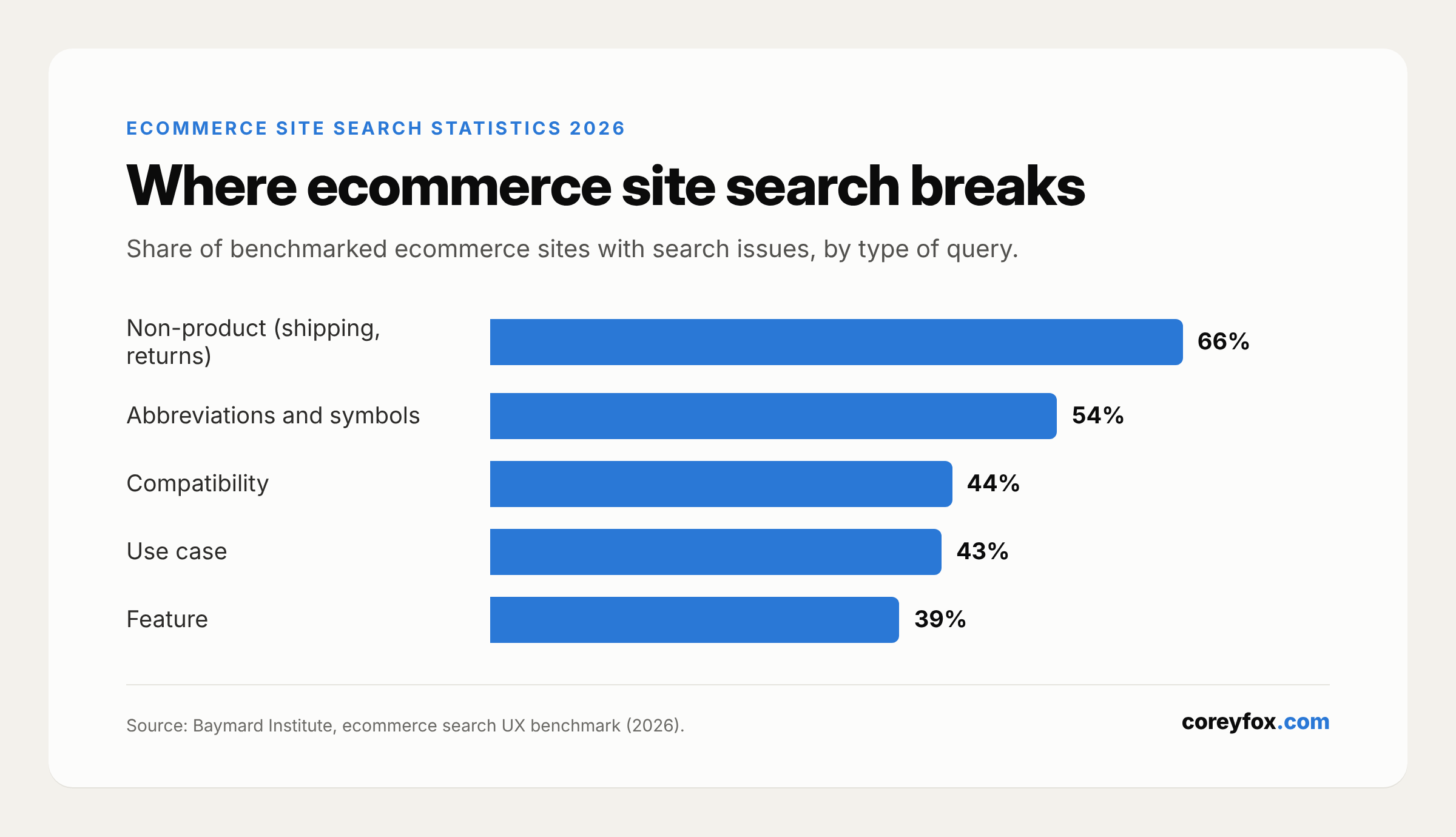
- 66% of sites have issues with non-product searches (shipping, returns, store info) (Baymard Institute, 2026)
- 54% of sites have issues with abbreviation and symbol searches, 44% with compatibility searches, 43% with use-case searches, and 39% with feature searches (Baymard Institute, 2026)
- Even simple product-type searches cause issues on 20% of sites (Baymard Institute, 2026)
- 80% of ecommerce sites offer search autocomplete, but only 19% get all the implementation details right (Baymard Institute, 2022)
- 69% of sites don’t offer relevant autocomplete suggestions for closely misspelled terms (Baymard Institute, 2021)
AI, semantic, and conversational search adoption
- 75.4% of US and UK consumers have used AI tools like Claude, ChatGPT, or Gemini to help with shopping or purchase decisions (Bloomreach, 2026)
- Forced to choose, 41.4% would shop through AI and 38% directly on a brand’s site; in Bloomreach’s 2025 survey it was 41.1% AI and 58.9% brand site (Bloomreach, 2026)
- 41.4% of US shoppers say they now use natural language when searching, and 61.3% are interested in a conversational search bar (Bloomreach, 2025)
- 58% of shoppers would be comfortable using conversational AI on a retail website, up from 42% in 2023 (Constructor & Shopify, 2025)
- 38% of shoppers have tried agentic shopping tools such as Amazon’s Rufus or Walmart’s Sparky (Constructor & Shopify, 2025)
- 77% of shoppers are often or sometimes unsure what to buy when they arrive at a retail site (Constructor & Shopify, 2025)
- 250 million shoppers used Amazon’s Rufus assistant in 2025, and Amazon expects it to drive over $10 billion in annual incremental sales (Fortune, 2025)
- Only 28% of B2C retailers offered conversational commerce in 2024, while 69% planned to add it within a year (Algolia, 2024)
- Generative AI traffic to US retail sites rose 693.4% year over year in the 2025 holiday season (Adobe, 2026)
- AI referrals to retail sites converted 31% better than other traffic sources during the 2025 holidays (Adobe, 2026)
- AI and agents influenced $262 billion, or 20%, of global 2025 holiday retail sales (Salesforce, 2026)
- Shoppers referred from AI search channels converted 9x more often than social media referrals (Salesforce, 2026)
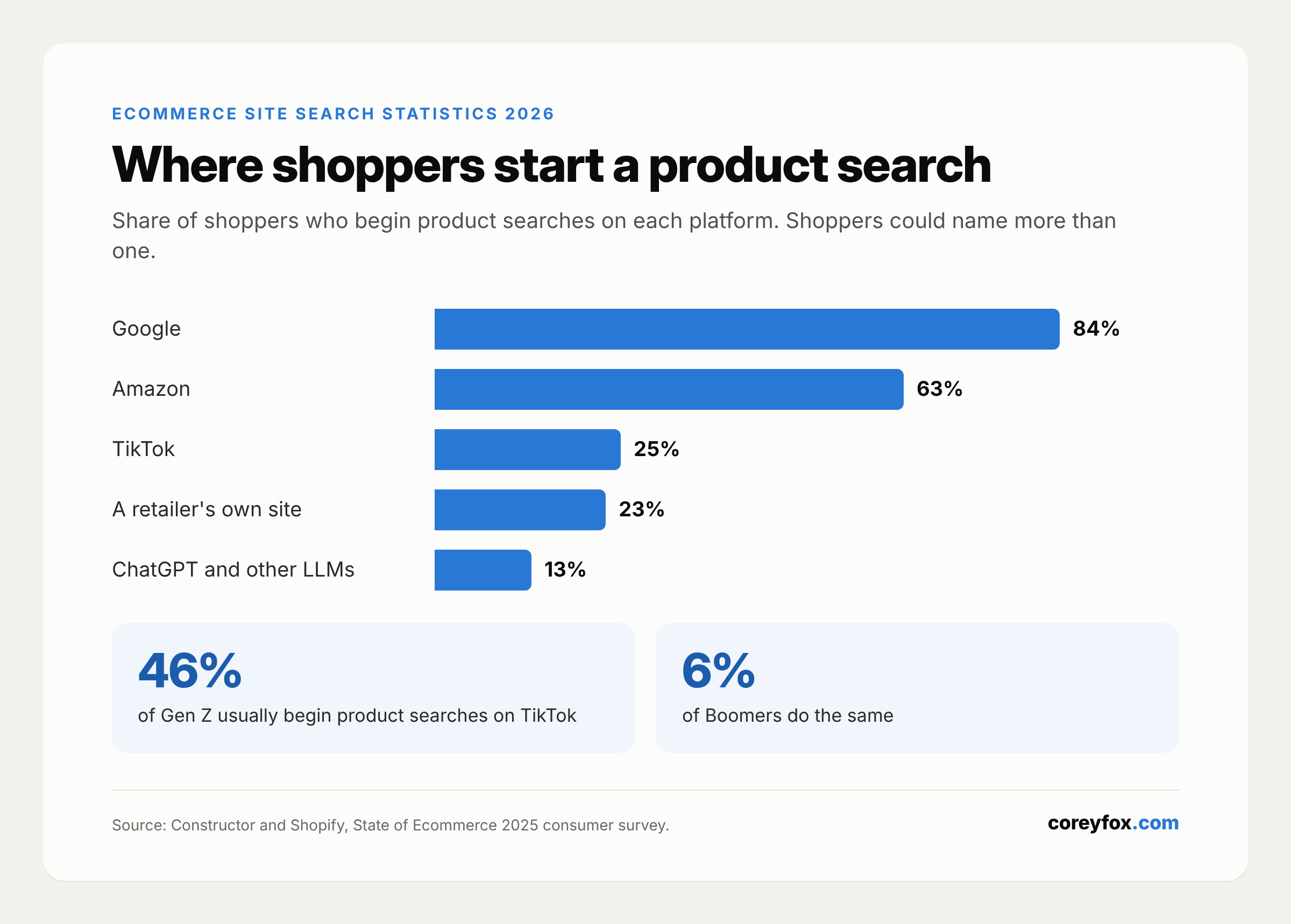
Where product searches start: Amazon vs Google vs AI vs TikTok
These surveys ask the question differently (single starting point vs “often begin”), so the totals don’t add to 100%.
- 84% of shoppers typically begin product searches on Google, 63% often begin on Amazon (75% in the US), 25% usually begin on TikTok, 23% on a retailer’s site, and 13% frequently start with LLMs like ChatGPT (Constructor & Shopify, 2025)
- 46% of Gen Z usually begin product searches on TikTok, versus 6% of Boomers (Constructor & Shopify, 2025)
- 56% of US consumers start product searches on Amazon, 42% on a search engine, 29% on Walmart.com, and 13% on YouTube (Jungle Scout via eMarketer, 2024)
- 90% of US Amazon customers began their shopping at Amazon.com in 2024; about 6% started with a Google search (CIRP, 2025)
- 19% of US adults (about 49.6 million) begin retail product research with AI (PYMNTS Intelligence, 2026)
- 49% of US consumers have used TikTok as a search engine, up from 41% in 2024 (Adobe Express, 2026)
- 14% of US consumers say they’re more likely to rely on ChatGPT than Google as a search engine (Adobe Express, 2026)
Mobile search behavior
- Smartphones accounted for 56.4% of US online transactions in the 2025 holiday season, up from 54.5% in 2024 (Adobe, 2026)
- 58% of mobile sites and 64% of ecommerce apps have “mediocre or worse” search UX, versus 46% of desktop sites (Baymard Institute, 2026)
- 34% of shoppers prefer retailer apps (50% of Gen Z), while 43% prefer websites (57% of Boomers) (Constructor & Shopify, 2025)
- 21% of sites don’t provide a submit button next to the mobile search field (Baymard Institute, 2021)
What this means for Shopify brands
- Your search log is free keyword research. The queries people type into your Shopify search bar are the exact language your buyers use. I pull them into the keyword map before touching any collection page, because they surface product types, use cases, and compatibility terms that never show up in a generic keyword tool.
- Every repeated query deserves a collection page. If shoppers keep searching “gifts for runners” or “fragrance free sunscreen,” build a real collection for it with a unique intro, filters, and internal links. That page fixes on-site findability and gives Google (and AI assistants) a page to rank and cite.
- Zero-result searches are lost revenue you can measure. Baymard’s data says most sites still miss non-product, abbreviation, and compatibility queries. Export your zero-result terms monthly and fix them with synonyms, redirects, or new products. My free Shopify Revenue Leak Audit flags where this is costing you.
- AI shopping assistants read your product data, not your design. With AI referrals converting better than other traffic and more shoppers starting in ChatGPT or Rufus, clean product schema (price, availability, variants, reviews, GTINs) is now part of search. The Shopify Schema Kit covers the markup most themes get wrong.
- Write for the questions, not just the keywords. Natural-language and use-case queries are growing. Product and collection copy that answers “is this good for X” or “does this work with Y” helps your on-site search, Google, and AI answers at the same time. That’s the core of my SEO/AEO retainer.
FAQ
What percentage of ecommerce shoppers use site search?
It depends on the store and vertical. Constructor’s 2025 analysis of 113 retail sites found searchers make up 24% of traffic, and Baymard says roughly half of its test participants prefer search as their main way to find products.
What is a good site search conversion rate?
Prefixbox measured an average site search conversion rate of 5.4% in H1 2024. Constructor found searchers convert at 2.5x the rate of non-searchers, so the better benchmark is your own searcher vs non-searcher ratio.
How much revenue comes from site search users?
Constructor’s 2025 study found searchers drive 44% of total ecommerce site revenue while making up 24% of traffic. In health and beauty, the revenue share was 57%.
What happens when a site search fails?
Most shoppers leave. Coveo found 72% of consumers leave a site when they can’t quickly find what they need, and 53% of those go to Google next, while Constructor and Shopify found 66% of shoppers have abandoned a retailer’s site for Amazon.
Where do most product searches start: Amazon or Google?
It depends on how the question is asked. Constructor and Shopify’s 2025 survey found 84% typically begin with Google and 63% often begin on Amazon, while Jungle Scout’s 2024 data showed 56% of US consumers start on Amazon versus 42% on a search engine.
Methodology and sources
Every statistic above was checked against the linked page in October 2026. I prioritized primary research from Baymard Institute, Adobe, Salesforce, Bloomreach, Constructor, Coveo, Algolia, PYMNTS Intelligence, and Google Cloud, and labeled each figure with the year the data was published. Vendor studies are named as vendor studies: Constructor, Bloomreach, Coveo, Algolia, Prefixbox, and Adobe all sell search, analytics, or commerce software, and their surveys and platform data reflect their customer bases. Where I couldn’t reach a vendor’s own press page, I linked the trade press or press release reprint that published the figures (Constructor’s 2025 search revenue study via ChannelLife; the Constructor and Shopify State of Ecommerce 2025 survey via Agile Brand Guide, with the report itself at info.constructor.com). The Google Cloud and Harris Poll figures are from 2021 and are included because they remain the most-cited consumer data on search abandonment. Older “roundup” stats I couldn’t trace to a dated original, such as the widely repeated 4.63% vs 2.77% searcher conversion figure, were left out.
If you cite these numbers, please link to this page and the original source.