SEO vs AEO: What’s the Difference, and Where Should Your Budget Go?
Last Updated on October 13, 2026 by Corey Fox
SEO (search engine optimization) is the practice of earning rankings in a search engine’s list of results. AEO (answer engine optimization) is the practice of earning citations inside AI-generated answers on ChatGPT, Perplexity, and Google AI Overviews. SEO wins the click when a buyer scans links. AEO wins the mention when a buyer just asks. In 2026, your buyer does both, so you need both.
That’s the definition. The more useful question is where they overlap, where they don’t, and what that means for your budget.
The core difference: a list vs an answer
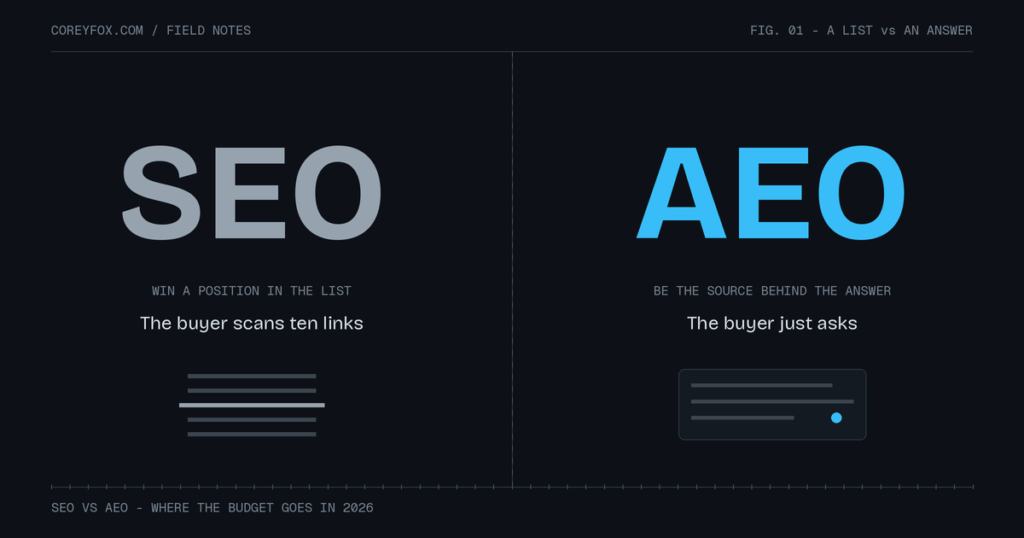
Google’s classic result page is a list. Ten links, and the buyer picks one. SEO is the fight for a position in that list: keywords, backlinks, technical health, content that satisfies the query better than nine other pages.
An answer engine doesn’t give the buyer a list. It gives them a conclusion. “For a store your size, the best options are X and Y.” The buyer never scans, never compares ten tabs. The engine did that, using the sources it trusts.
SEO optimizes for the scan. AEO optimizes for being the source behind the conclusion.
Side by side
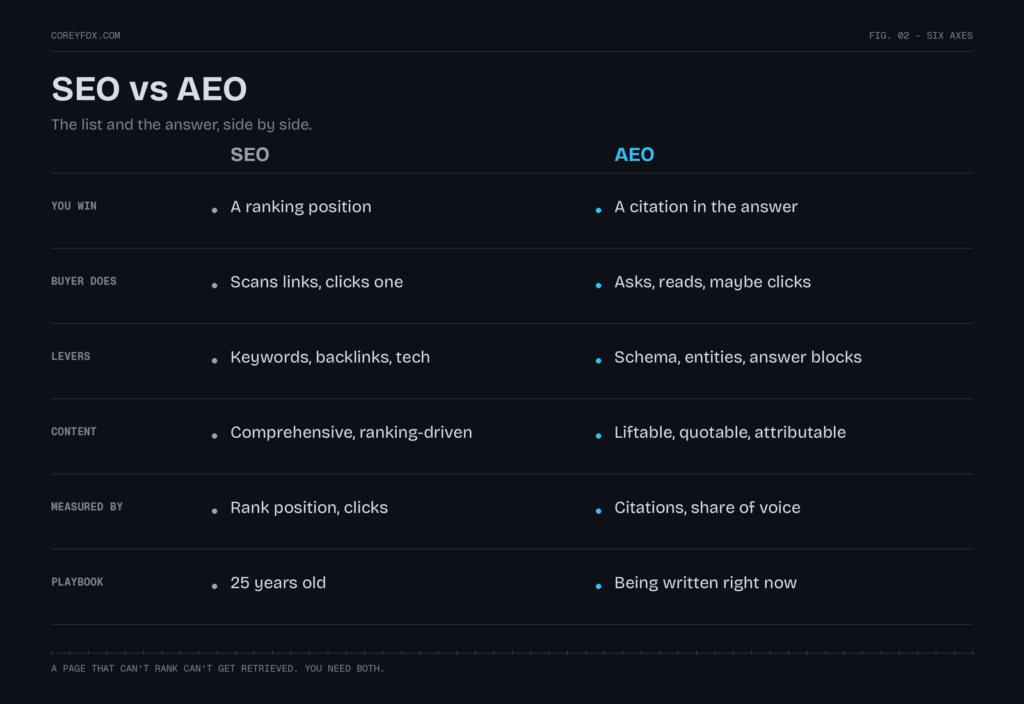
| SEO | AEO | |
|---|---|---|
| Output you win | A ranking position | A citation or mention in the answer |
| Buyer behavior | Scans links, clicks one | Asks, reads, maybe clicks a source |
| Core levers | Keywords, backlinks, technical health | Schema, entities, answer-block structure |
| Content style | Comprehensive, ranking-driven | Liftable, quotable, attributable |
| Measured by | Rank position, organic clicks | Citations, mentions, share of voice |
| Mature or new | 25 years of playbooks | Playbook still being written |
Where they overlap (this is the part most posts get wrong)
AEO isn’t a replacement discipline bolted on top of SEO. It’s built on it.
AI Overviews are generated from Google’s index. Perplexity retrieves from ranked results. ChatGPT’s browsing pulls from pages that already have authority signals. A page that can’t rank can’t get retrieved, and a page that can’t get retrieved can’t get cited.
So the stack looks like this: SEO gets you indexed and ranked. AEO gets you cited. And the third layer, getting your brand named even without a citation, is GEO, which I covered in AEO vs GEO.
About 80% of technical SEO work counts double. Clean site architecture, fast pages, and crawlable content serve both. The 20% that’s AEO-specific is what most SEO retainers skip: schema depth beyond the basics, entity definitions, and restructuring content into direct answer blocks a machine can lift and attribute.
Where they diverge
Content structure. SEO content in 2020 meant 3,000-word comprehensive guides. AEO content means the answer in the first 50 words, then the depth. An engine quoting you doesn’t quote paragraph 14.
Measurement. Rank trackers don’t see AI answers. You can hold position 3 and be invisible in the AI Overview above it, which absorbs the click. Different problem, different instrument. Grade any page’s citability in two minutes with the free Citability Scorer.
Competition. Your SEO competitors are whoever ranks. Your AEO competitors are whoever gets cited, and it’s often a different list: publications, review sites, and one structurally smart competitor who moved early.
So where does the budget go?
If your SEO foundation is broken, fix that first. AEO on an uncrawlable site is decoration.
If your rankings are fine but traffic is sliding, that’s the AI layer eating your clicks, and more SEO spend won’t stop it. Shift budget to AEO: schema, entities, answer blocks, and measurement of where you appear across engines. That’s the work I do in AEO services, and the full mechanics are in What is AEO.
The split I recommend for most mid-market brands in 2026: keep the SEO maintenance layer running, put the growth budget into AEO. Ranking maintenance is defense. Citations are the open territory.
FAQs
Is AEO replacing SEO? No. AEO depends on SEO. Retrieval runs on ranked, indexed pages. What AEO replaces is the assumption that a ranking alone still earns the click.
Do I need separate teams for SEO and AEO? No, and paying twice for overlapping work is the main way brands waste money here. You need one strategy that treats citations as an output alongside rankings.
Which shows results faster? AEO, usually. Citation movement shows up in 60-90 days after implementation because you’re often the first in your category doing the structural work. Competitive SEO rankings take longer because everyone’s already fighting there.
How do I know if I have an AEO problem? Rankings stable, clicks falling. That signature almost always means answers are absorbing your traffic. Put a number on it with the free revenue audit.
Want to see exactly which answers your buyers get without you in them? Get the free revenue audit. 8 minutes of analysis, a 20-minute call, no pitch.