ChatGPT SEO Tools + 50 Prompts That Actually Move Rankings
Last Updated on July 22, 2026 by Corey Fox
ChatGPT works as an SEO tool for five jobs: keyword expansion, content briefs and drafts, technical audit triage, schema generation, and competitor analysis. It does not work as a rank tracker, a backlink index, or a source of search volume data, because it has none. Use it for thinking and production, pair it with real data tools, and it earns its subscription many times over.
That’s the honest scope. Now the part most “ChatGPT for SEO” posts skip: the actual prompts, written the way I use them in client work, not “write me a blog post about X.”
The rule that makes every prompt below work
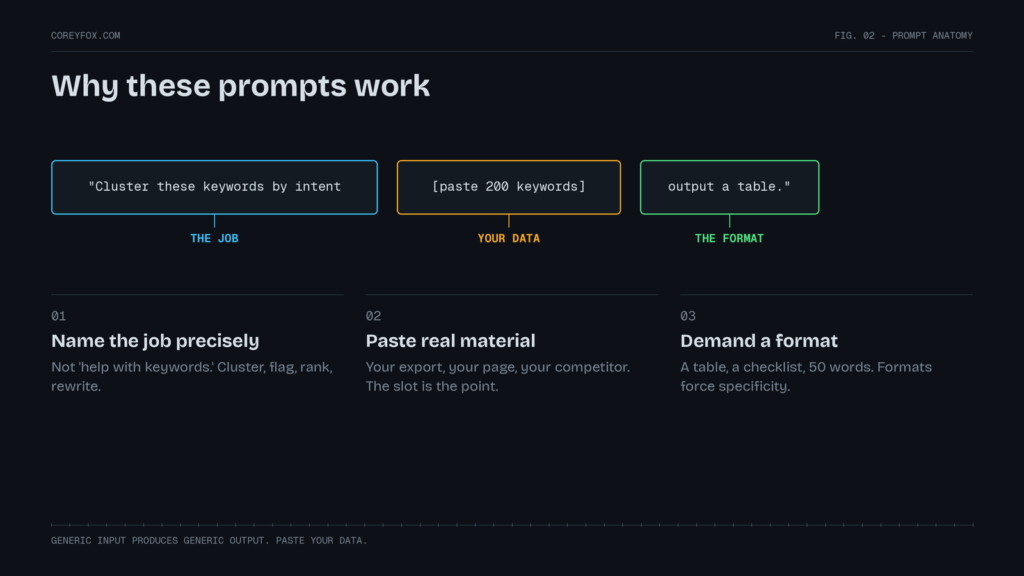
Give it your data. ChatGPT with no context produces generic output because you gave it a generic input. Every prompt below has a slot for YOUR export, YOUR page, YOUR competitor. Paste real material into the brackets and the output stops sounding like everyone else’s.
Where the prompts need live SERP data, pull it free with my Google SERP Checker first and paste the results in.
Keyword research prompts (1-8)
- “Here are 200 keywords from my Search Console export: [paste]. Cluster them by search intent (informational, commercial, transactional) and by topic. Output a table.”
- “For the topic [X], list 25 questions a [buyer persona] would ask an AI assistant, phrased conversationally, not as search queries.”
- “Here’s my keyword list: [paste]. Flag every keyword where the intent is ambiguous and tell me what two page types could satisfy it.”
- “Take these 30 seed keywords: [paste]. Generate long-tail variants under 4 words of the seed that a small site could realistically rank for.”
- “Here are the top 10 titles ranking for [keyword]: [paste from SERP checker]. What intent is Google rewarding, and what format should my page take?”
- “Group these keywords into pillar and spoke structure: [paste]. One pillar per cluster, spokes underneath, note which spoke should publish first.”
- “Which of these keywords are likely to trigger an AI Overview, and why: [paste]? Base it on query type: definitions, comparisons, how-tos.”
- “I rank position [X] for [keyword] with this URL: [URL]. List every subtopic the top 3 cover that my page doesn’t.”
Content brief and drafting prompts (9-18)
- “Build a content brief for [keyword]: target intent, H2 outline, entities to include, questions to answer, word count range, and the direct answer block for the first 50 words.”
- “Write a 45-word direct answer for the question [X] that a machine could lift and attribute. No preamble, no ‘it depends.'”
- “Here’s my draft: [paste]. Rewrite the intro so the answer appears in the first two sentences.”
- “Here’s a competitor’s ranking page: [paste text]. List what it covers, what it misses, and the 3 sections I should add to beat it.”
- “Turn this paragraph into a comparison table: [paste].”
- “Write 10 title options for [topic] under 60 characters. No colons-plus-cliché patterns, no ‘ultimate guide.'”
- “Here’s my article: [paste]. Generate the FAQ section: 4 questions real buyers would ask, answers under 50 words each, formatted for FAQPage schema.”
- “Rewrite this section in my voice. Here are 3 samples of my writing: [paste]. Here’s the section: [paste].”
- “Here’s my post: [paste]. Which claims need a citation, a number, or a named source to be credible?”
- “Summarize this 2,000-word post into a 150-word version that keeps every specific fact and drops every filler sentence.”
Technical SEO prompts (19-28)
- “Here’s a Screaming Frog export of status codes: [paste]. Group the issues by severity and tell me the 5 fixes that unblock the most indexable pages.”
- “Explain what’s wrong with this canonical setup and how to fix it: [paste URLs and canonical tags].”
- “Here’s my robots.txt: [paste]. What am I blocking that I shouldn’t be, including AI crawlers?”
- “This page has LCP of [X]s. Here’s the Lighthouse opportunities list: [paste]. Rank the fixes by expected LCP gain.”
- “Write the .htaccess 301 rules for these redirects: [paste old and new URLs].”
- “Here’s my sitemap URL list: [paste]. Which URLs look like they shouldn’t be indexed at all?”
- “Compare these two hreflang implementations and tell me which is broken and why: [paste].”
- “Here’s a server log sample: [paste]. What percentage of crawl is going to parameter URLs and pagination, and what robots rules would fix it?”
- “My page is in Google’s index but ranks nowhere. Here’s the page text and title: [paste]. Give me the 5 most likely causes ranked by probability.”
- “Generate the redirect map for a domain migration from [old] to [new]. Here are both URL lists: [paste].”
Schema and AEO prompts (29-38)
- “Generate FAQPage JSON-LD for these questions and answers: [paste]. Valid schema.org, no markdown.”
- “Generate Article schema for this post: [paste title, author, dates, URL]. Connect the author to the Person entity at [your #id].”
- “Here’s my JSON-LD: [paste]. Validate it mentally against schema.org requirements and list every missing recommended property.”
- “What schema types should exist on a [page type] page, and in what structure? Output as a checklist.”
- “Here’s my service page: [paste]. Rewrite the opening 60 words so it directly answers ‘what is [service] and who is it for’ in liftable form.”
- “List the entities on this page a machine would extract: [paste]. Which are ambiguous, and what would disambiguate them?”
- “Write 15 conversational buyer prompts I should track for AI visibility in the [niche] category.” (Then run them through my AI Citation Checker.)
- “Here’s an AI Overview answer for my target query: [paste]. Which sources did it synthesize, and what would my page need to be cited alongside them?”
- “Rewrite this how-to as numbered steps with one action per step, ready for HowTo schema: [paste].”
- “Here’s my page: [paste]. Score its citability 1-10 on: answer-first structure, verifiable claims, clear attribution, entity clarity. Explain each score.”
Competitor and analysis prompts (39-45)
- “Here are 3 competitor homepages: [paste text]. Build a positioning map: who claims what, and what position is unclaimed.”
- “Here’s my competitor’s sitemap URL list: [paste]. What topic clusters have they built that I haven’t?”
- “Compare my title tags to theirs for the same 20 keywords: [paste both]. Where is their phrasing matching intent better?”
- “Here’s a competitor’s new post: [paste]. What keyword are they targeting, what’s the format, and should I respond with content or ignore it?”
- “Here are my top 20 pages by traffic and theirs: [paste]. What does the difference say about our respective strategies?”
- “Here’s their backlink anchor text distribution: [paste]. What does it suggest about their link building approach, and any over-optimization risk?”
- “Summarize this competitor’s entire blog category page into their content strategy in 5 bullets: [paste].”
Reporting and client prompts (46-50)
- “Turn this data into 3 plain-English sentences for a CMO who doesn’t know SEO: [paste metrics].”
- “Write the ‘what happened and why’ section of a monthly report from this Search Console data: [paste]. No jargon, lead with the number that matters.”
- “Here’s a ranking drop: [paste keyword, dates, positions]. List the diagnostic steps in order, cheapest check first.”
- “Draft a scope-of-work section for [service] with deliverables, timeline, and what’s explicitly excluded.”
- “Here’s my audit output: [paste]. Compress it to a one-page priority list: Critical / This month / This quarter.”
The tools that pair with these prompts
ChatGPT supplies zero live data, so every data slot above needs a source. The free stack: my Google SERP Checker for live SERPs, Search Console for your own queries, and the AI visibility tools covered separately for citation tracking. Where SEO ends and AEO begins with all of this is covered in SEO vs AEO.
FAQs
Is ChatGPT good for SEO? For thinking and production work: keyword clustering, briefs, drafts, schema, audit triage, yes. For anything requiring live data: rankings, volumes, backlinks, no. It has no index.
Can Google detect and penalize ChatGPT content? Google’s stated position targets unhelpful content, not AI-assisted content. Generic unedited AI output fails because it’s generic, not because it’s AI. Everything above assumes you feed real data in and edit what comes out.
Which model should I use for SEO work? Whichever current model you have access to, with your data pasted in. The prompt and the input matter more than the model version for these tasks.
Do these prompts work in Claude or Gemini? Yes, all 50. The structure (role, your data, specific output format) is model-agnostic.
Want these 50 as ready-to-run skills instead of copy-paste prompts? The free SEO Skills Pack packages my working prompt library. And if you’d rather see what an AI-assisted audit finds on your own site, get the free revenue audit.