AI Citation Checker
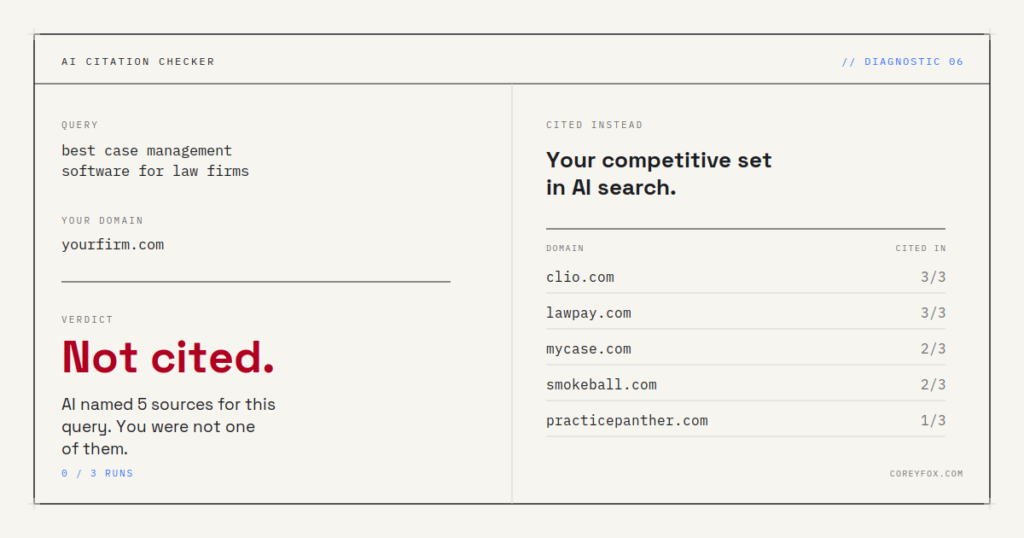
When AI answers a question in your category, it names a handful of companies and ignores everyone else. The AI Citation Checker runs your query against a live answer engine and tells you whether you are one of them, or which competitors are being recommended in your place.
Enter your domain and the question a prospect would ask AI. The checker runs the query against a live answer engine and reads back every source it cited, then tells you whether you are one of them.
Takes 5 to 15 seconds. The checker queries a live answer engine, so it reports what AI says right now.
Unlock the full report: the query runs three times to measure how consistently you are cited, plus the ranked list of every source AI names for it.
The AI Citation Checker is a free tool that runs any query through a live AI answer engine and reports every source it cites, then tells you whether your domain is among them. Enter your domain and a query your customers would ask, and see who AI recommends when you are not in the room.
What is an AI citation?
An AI citation is a source an answer engine names when it composes a response. When ChatGPT, Perplexity, or Google AI Overviews answers a question, it pulls from a small set of sources and credits them.
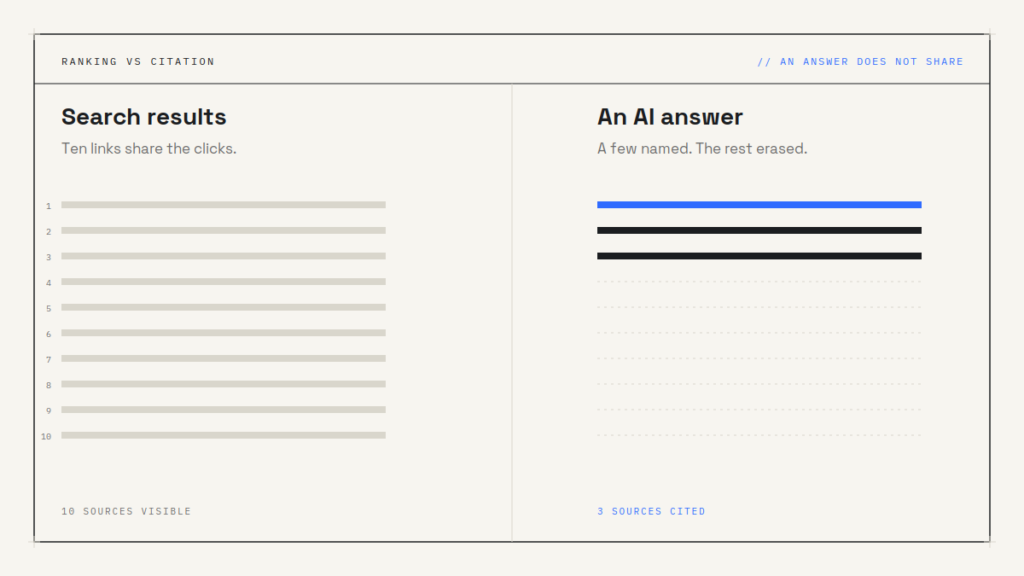
Being cited is the AI-search equivalent of ranking, except the list is far shorter.
Ten results can rank on a search page and share the clicks. An AI answer does not share. It names a few sources and erases the rest, which means the gap between cited and almost cited is the gap between being recommended and not existing.
The hardest part is that absence is invisible. A click that never happens leaves no trace in your analytics, so a business can lose consideration for months without a single number moving on a report.
What the checker measures
| Signal | What it tells you |
|---|---|
| Cited or not cited | Whether your domain appears among the sources the engine named for your query. |
| Who was cited instead | Your actual competitive set in AI search, which is often not the competitors you track. |
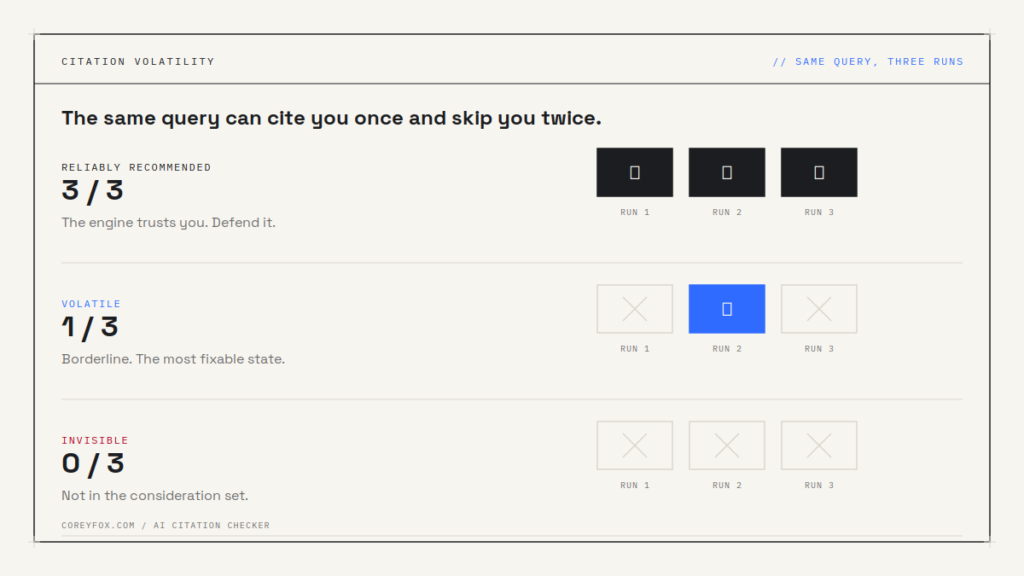
| Citation consistency | How many of three identical runs cite you. Consistent citation means the engine trusts you. Intermittent citation means you are borderline. |
| Source dominance | Which domains get cited across every run, revealing who owns the answer for your query. |
The free check reports the verdict and who was cited instead. The full report adds the three-run consistency measure and the ranked source list.
What the verdict means
| Result | Band | What it tells you |
|---|---|---|
| Cited in 3 of 3 runs | Reliably recommended | The engine trusts you as a source for this query. Defend the position. |
| Cited in 1 to 2 of 3 runs | Volatile | You are borderline. The raw material is there, but the structure is not solid enough to win the slot every time. This is the most fixable state. |
| Cited in 0 of 3 runs | Invisible | You are not in the consideration set. You may rank on Google and still never appear in the answer. |
Volatility is the finding most businesses have never seen, because no traditional tool measures it. It is the gap between almost visible and reliably recommended.
Why AI cites one company over another
- Entity clarity. The engine has to be certain who you are, what you do, and where. Ambiguous or inconsistent identity signals make you a risky source to name.
- Extractable structure. A direct answer stated plainly near the top of a page beats the same fact buried in paragraph nine. Models cite what they can lift cleanly.
- Corroboration. Your claims about yourself carry less weight than the same facts confirmed elsewhere. Consistent description across the web turns a claim into a fact the model will repeat.
- Specificity. Concrete numbers, named methods, and original data get cited. Generic marketing language gets skipped, because there is nothing in it worth quoting.
- Freshness. Dated, maintained content signals a source worth trusting now rather than a page that was true three years ago.
None of these are traditional ranking factors. That is exactly why sites that rank well can still be invisible in AI answers.
To see why a specific page does or does not earn the citation, run it through the Citability Scorer. To measure what the lost citations already cost you, run the AI Overviews Revenue Leak Diagnostic.
What this costs you
Take your average customer value and multiply it by the deals decided before anyone ever visits your site.
That is the number, and it is invisible in every report you currently look at.
The companies your check just named are the ones getting that consideration by default.
If your domain came back uncited on a query that matters, book the AI Visibility Audit or review the service tiers for what full citation engineering looks like.
Related instruments: check what AI says when prospects ask about your brand with the Brand Hallucination Auditor, and see which answer blocks your query triggers with the AI Overview & SERP Feature Checker.
Frequently asked questions
Is the AI Citation Checker free?
Yes. The verdict and the list of who was cited instead are free with no signup. Your email unlocks the three-run consistency measure and the ranked source list. There is no paid version.
Which AI engine does this check?
Perplexity, because it exposes its citations directly and returns them fast enough for a live check. Its citation behavior is a strong proxy for how answer engines in general select sources. The full audit covers ChatGPT and Google AI Overviews as well.
Why did I get a different result the second time?
AI citations are volatile. The same query can cite you on one run and skip you on the next. That inconsistency is a finding, not a bug, which is why the full report runs the query three times and reports how many times you appeared.
Does being cited mean I am ranking on Google?
No, and that is the point. Ranking and citation are different systems with different selection criteria. Plenty of sites rank well and are never cited. Some get cited without ranking at all.
Can I check a competitor’s domain?
Yes, any domain. Checking the competitor currently cited for your query, then comparing what their page does differently, shows precisely what the engine preferred about them.
How often should I re-check a query?
Monthly for the queries that drive revenue. Citation sets shift as engines update and as competitors restructure their pages. A query you own today is not a query you own permanently.
Is my data stored?
The free check stores nothing. If you request the full report, your email and the query you ran are saved so the results can be sent to you.